
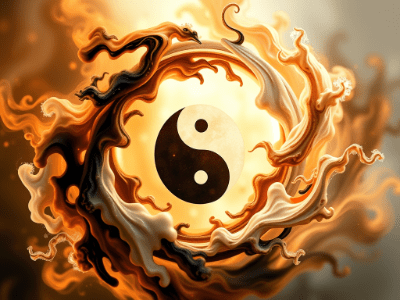
The Yin Yang symbol is well know in popular culture and can be found on all sorts of items from t-shirts to tattoos. While it is an essential part of Daoism (Taoism), it is often misunderstood. Many see Yin Yang as opposites like cold v. hot or good v. evil, but this is too simple a concept.
Complimentary Forces
Yin Yang do not so much oppose each other as they compliment one another. Yin is needed for Yang to exist. Without ugliness there can be no beauty. Without sour there can be no sweet. They shape each other and define each other.
“When everyone in the world see beauty, Then ugly exists. When everyone sees good, Then Bad exists. Therefore: What is and what is not create each other. Tall and short shape each other. High and low rest on each other.”
Dao De Jing, Chapter 2
Taking this even further creation and non-creation need each other. Creation comes from nothing and nothing comes from creation. Another way to say this is that being comes from non-being and non-being comes from being.
“All things in the world are born out of being. Being is born out of non-being.”
Dao De Jing, Chapter 40

Constant Change
The interaction between Yin and Yang creates constant change making each moment unique. They create harmony by blending together. Some days its hotter, other days colder. Some days you are more social and other days more reserved.
“All things carry yin and embrace yang. They reach harmony by blending with the vital breath.”
Dao De Jing, Chapter 42
Yielding
Although there is a time and place for assertive action, the Dao teaches that it is also necessary to yield. The Dao does not contend, but still achieves. It is laid back, but still plans. The concept of Wu Wei, or effortless action, illustrates this concept. One should go with the flow of life and act only when it is effortless and compliments the Dao.
“Heaven’s way does not contend, yet it certainly triumphs. It does not speak, yet it certainly answers. It does not summon, yet things come by themselves. It seems to be at rest, yet it certainly has a plan.”
Dao De Jing, Chapter 73
Lessons for Government
Nations should also abide by the Dao. Laozi (Lao Tzu) taught that nations should follow Wu Wei and be willing to yield to one another. Larger nations should not dominate smaller ones, because this leads to push back and conflict. Larger nations should be willing to yield and accommodate smaller ones to create positive and long lasting relationships.
“If a great country yields to a small country, it will conquer the small country. If a small country yields to a great country, it will be conquered by a great country. So, some who yield become conquerors, and some who yield get conquered.”
Dao De Jing, Chapter 61
Lessons for the Individual
The constant change of Yin and Yang has important implications for the individual. It is foolish to think that life will always remain the same. Yin and Yang are constantly interacting creating change. The individual should assume that change is constant and develop a flexible attitude staying in the moment and reacting accordingly.
“People are born soft and weak. They die hard and stiff. All things such as grass and trees are soft and supple in life. At their death they are withered and dry. So, the hard and stiff are death’s companions. The soft and weak are life’s companions.”
Dao De Jing, Chapter 76
A person should be willing to embrace both Yin and Yang. Sometimes they should be outgoing while other time more reserved and contemplative. They should embrace both the masculine and feminine.
“Knowing the manly, but clinging to the womanly. Knowing the you become the valley of the world. Being the valley of the world, eternal virtue will never desert you, and you become like a little child anew.”
Dao De Jing, Chapter 28
 Daoism