

Master Zhuang is the second most influential writer in Daoism (Taoism) and the book Zhuangzi was named after him. Chapter Four is In the World of Men and teaches how to reform someone without virtue.
Reforming One without Virtue
The Zhuangzi used historical figures such as Confucius to teach about the Dao. Yan Hui asked Confucius for permission to go to Wei to reform a violent ruler. Confucius advised against going, warning that he likely would be killed.
“if you do not understand men’s minds but instead appear before a tyrant and force him to listen to sermons on benevolence and righteousness, measures and standards —this is simply using other men’s bad points to parade your own excellence. You will be called a plaguer of others. He who plagues others will be plagued in turn. You will probably be plagued by this man.”
If he was fortunate enough not to be executed, he would probably still fail. Rulers are experts at bringing others to their side and can convince others to support them. Besides, one should be sure they have virtue in themselves before you try to reform others.
“Keep your advice to yourself! Kings and dukes always lord it over others and fight to win the argument. You will find your eyes growing dazed, your color changing, your mouth working to invent excuses, your attitude becoming more and more humble, until in your mind you end by supporting him. This is to pile fire on fire, to add water to water, and is called ‘increasing the excessive’.”
Yan Hui asked if he could reform the ruler by being resolute. Confucius responded that the ruler may make outward signs of reform but would never truly do so.
“He will stick fast to his position and never be converted. Though he may make outward signs of agreement, inwardly he will not give it a thought!”
Not giving up easily, Yan Hui suggested outwardly agreeing with the ruler but remaining inwardly resolute. He could quote the words of historical teachers. Confucius responded, that he may avoid punishment, but would still not convert the tyrant.
“You will probably get off without incurring any blame, yes. But that will be as far as it goes. How do you think you can actually convert him?”
The Daoist Approach
The Daoist approach to reform others is to be resolute inwardly and follow your own way. Don’t be motivated by fame or look for personal gain. Forget ego and be in a state of emptiness. Give the person advice only if they are willing to listen, otherwise remain silent.
“You may go and play in his bird cage but never be moved by fame. If he listens, then sing; if not, keep still. Have no gate, no opening, but make oneness your house and live with what cannot be avoided. Then you will be close to success.”
Yan He wanted to reform the prince of Wei. Ju Boyu advised him to support the prince’s actions outwardly, but to be careful not to get drawn into his actions so much as be condemned by others.
“If he wants to be a child, be a child with him. If he wants to follow erratic ways, follow erratic ways with him. If he wants to be reckless, be reckless with him. Understand him thoroughly, and lead him to the point where he is without fault”
The Ambassador
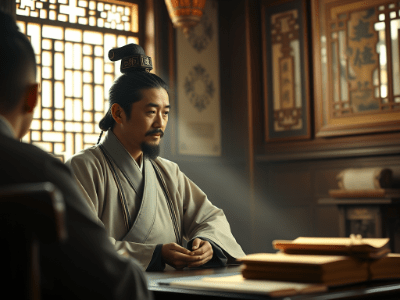
Ambassador Zigao of She asked Confucius for advice on his upcoming mission. Confucius reminded Zigao of the two great decrees: the duty to parents and to the nation. However, the greatest virtue is not to allow outside factors to affect your personal way and accept that there are things that you can not change.
“To serve your ruler and be content to do anything for him—this is the peak of loyalty. And to serve your own mind so that sadness or joy does not sway or move it; to understand what you can do nothing about and to be content with it as with fate—this is the perfection of virtue.“
Confucius went on to give advice on being a messenger. A messenger feels pressure to please both sides by exaggerating the positives. Exaggeration is irresponsible and reduces credibility. Inaccurate words can put the messenger in danger.
“’Transmit the established facts; do not transmit words of exaggeration.’ If you do that, you will probably come out all right.”
The messenger should never go beyond their orders or press too hard for agreement. A lasting agreement takes time and a bad agreement is hard to change. One should accept what you can’t change and focus on your own personal way.
“Do not deviate from your orders; do not press for completion.’ To go beyond the limit is excess; to deviate from orders or press for completion is a dangerous thing. A good completion takes a long time; a bad completion cannot be changed later. Can you afford to be careless?”
“Just go along with things and let your mind move freely. Resign yourself to what cannot be avoided and nourish what is within you—this is best.”
Usefulness

Trees feature prominently in Daoist thought. The carpenter Shi went to Qui and saw an enormous oak tree with its lowest branches 80 feet off the ground. He called the tree worthless because it could not be used for timber, boats, or doors. Shi had a dream where the Oak tree visited saying it was not useless because it sheltered hundreds of people. Besides, “useful” trees do not get to live out their normal lifespan because they are cut down prematurely.
“Their utility makes life miserable for them, and so they don’t get to finish out the years Heaven gave them but are cut off in mid-journey.”
In a similar episode, Ziqi of Nanbo saw a large tree in which thousands of horses could take shelter. Even though its gnarled and pitted limbs made it “useless” as timber, it was used by Holy Men for gatherings.
“It turns out to be a completely unusable tree,” said Ziqi, “and so it has been able to grow this big. Aha!—it is this unusableness that the Holy Man makes use of!”
A disabled man named Shu had a twisted body and could not stand straight. He survived by washing other people’s clothes and getting handouts. In-spite of his physical disabilities he got by and lived out his normal years. He avoided conscription by the army and his physical disability paled in comparison to a disability of virtue.
“With a crippled body, he’s still able to look after himself and finish out the years Heaven gave him. How much better, then, if he had crippled virtue!”
Finally, Jie Yu was called the madman of Chu because he would cry out in public that the past was gone and the future would never arrive. The sage succeeds with the Dao and simply survives without it. No one can truly know the usefulness of something.
“When Confucius visited Chu, Jie Yu, the madman of Chu, wandered by his gate crying, “Phoenix, phoenix, how has virtue failed! The future you cannot wait for; the past you cannot pursue. When the world has the Way, the sage succeeds; when the world is without the Way, the sage survives.”
“All men know the use of the useful, but nobody knows the use of the useless!”
Conclusion
Trying to reform others can be dangerous and lead to failure. One must be sure in their own virtue before reforming others. The best approach is to be inwardly resolute and following your own personal way. Don’t be motivated by fame and only give advice if the other person is willing to listen.
A messenger should never exaggerate or press for an agreement. Twisted trees may appear useless but often have an unforeseen purpose living out its normal years. Twisted virtue is much worse than having a twisted body.
 Daoism