
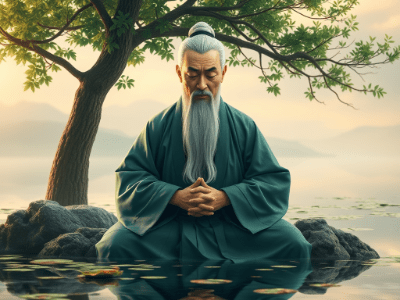
Master Zhuang is the second most influential writer in Daoism (Taoism) and the book Zhuangzi was named after him. Chapter Five is The Sign of Virtue Complete and describes what a sage looks like who is in a state of virtue.
Interconnectedness
One enters this state when they shift their perspective to be in harmony with the Dao.
“Men do not mirror themselves in running water—they mirror themselves in still water. Only what is still can still the stillness of other things.”
“ Massive and great, he perfects his Heaven alone.”
They can be in harmony by viewing all of creation as interconnected. The Dao becomes a guide and one sees the unity of all things.

“But if you look at them from the point of view of their sameness, then the ten thousand things all are one. A man like this doesn’t know what his ears or eyes should approve—he lets his mind play in the harmony of virtue.“
Admit Faults
Those approaching virtue admit to their faults and do not make excuses for their past behavior. They do not care for fame or reputation.
“People who excuse their faults and claim they didn’t deserve to be punished—there are lots of them. But those who don’t excuse their faults and who admit they didn’t deserve to be spared—they are few. To know what you can’t do anything about and to be content with it as you would with fate—only a man of virtue can do that.”
In the Moment

They are focused on the moment and do not allow joy or sorrow to affect them. They simply let things be as they are.
“When I talk about having no feelings, I mean that a man doesn’t allow likes or dislikes to get in and do him harm. He just lets things be the way they are and doesn’t try to help life along.”
They make no plans and do not allow loss to affect them. They do not care for profit, but only are concerned with being in harmony with the Dao.
“The sage hatches no schemes, so what use has he for knowledge? He does no carving, so what use has he for glue? He suffers no loss, so what use has he for favors? He hawks no goods, so what use has he for peddling? These four are called Heavenly Gruel.”
The Body
If someone has virtue the body is unimportant. It does not matter if someone is ugly, poor, or powerless. A man of virtue named Ai Taituo was considered ugly and was not powerful or wealthy. However, women wanted to be near him and the rich wanted him to run their estates.
“Therefore, if virtue is preeminent, the body will be forgotten. But when men do not forget what can be forgotten but forget what cannot be forgotten—that may be called true forgetting.“
Physical disabilities or limitations are unimportant. The body is simply seen as a dwelling.
“As for things, he sees them as one and does not see their loss. He regards the loss of a foot as a lump of earth thrown away.”
Life and Death

In this state one is unconcerned about life and death or the events of the day. The world could come to an end and it would not affect them.
“Life and death are great affairs, and yet they are no change to him. Though heaven and earth flop over and fall down, it is no loss to him. He sees clearly into what has no falsehood and does not shift with things. He takes it as fate that things should change, and he holds fast to the source.”
They do not fear death but see life and death as part of the Dao. Wang Tai was in virtue and many wanted to be his disciples. It didn’t matter that he had been a criminal or that he didn’t formally teach.
“Why don’t you just make him see that life and death are the same story, that acceptable and unacceptable are on a single string? Wouldn’t it be good to free him from his handcuffs and fetters?”
Conclusion
The Sage is one who is in a state of virtue. One enters this state when they are in harmony with the Dao and view all of creation as interconnected. They can admit their faults and do not care for fame or wealth. They live in the moment and do not allow sorrow to affect them. It doesn’t matter if the person is ugly, poor, or without power. They are not concerned with death and see the body as a dwelling.
“Life, death, preservation, loss, failure, success, poverty, riches, worthiness, unworthiness, slander, fame, hunger, thirst, cold, heat—these are the alternations of the world, the workings of fate. Day and night they change place before us, and wisdom cannot spy out their source. Therefore, they should not be enough to destroy your harmony.”
 Daoism