
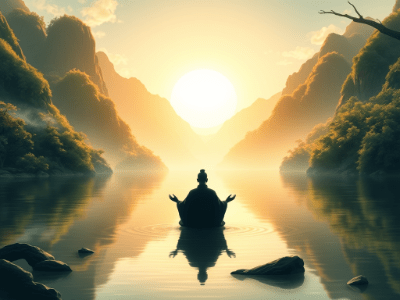
The book Zhuangzi is an essential text in Daoism. Chapter Eighteen, Supreme Happiness, centers on the question of what do humans value? Can money buy happiness? What must a person do to be happy?
Happiness
This chapter begins with the essential question, “Can one be happy in life?”
“Is there such a thing as supreme happiness in the world, or isn’t there? Is there some way to keep yourself alive, or isn’t there? What to do, what to rely on, what to avoid, what to stick by, what to follow, what to leave alone, what to find happiness in, what to hate?”
Human Values
Humanity values wealth, reputation, power, and long life. Many find happiness in fashionable clothes, rich food, leisure activities, music, and beauty. Humanity doesn’t value poverty, a short life, or a hectic lifestyle.
“This is what the world honors: wealth, eminence, long life, a good name. This is what the world finds happiness in: a life of ease, rich food, fine clothes, beautiful sights, sweet sounds. This is what it looks down on: poverty, meanness, an early death, a bad name. This is what it finds bitter: a life that knows no rest, a mouth that gets no rich food, no fine clothes for the body, no beautiful sights for the eye, no sweet sounds for the ear.”
Wealthy

The wealthy rush around all day accumulating wealth. They engage in complex business dealings, long term planning, and questionable schemes. They accumulate more wealth than they could possibly use in their lifetime. They worry if they are making the right decisions.
“People who are rich wear themselves out rushing around on business, piling up more wealth than they could ever use — this is a superficial way to treat the body. People who are eminent spend night and day scheming and wondering whether they are doing right — this is a shoddy way to treat the body.”
Wealth does not bring one true happiness. The rich are too rushed and can’t slow down to enjoy the moment. They are constantly worrying about protecting their possessions. They convince themselves that money will make them happy.
“What ordinary people do and what they find happiness in — I don’t know whether or not such happiness is, in the end, really happiness. I look at what ordinary people find happiness in, what they all make a mad dash for, racing around as though they couldn’t stop — they all say they’re happy with it.”
True Happiness
The sage does not accumulate possessions. They find true happiness in the state of Wu Wei or effortless action. They follow the natural contours of life and do not force anything. They only take action after much reflection and when it seems natural in the moment. This state of “inaction” brings peace and clarity and helps determine what is right and wrong. It feels as if things get done all by themselves and everything that needs to gets done gets done.
“I take inaction to be true happiness, but ordinary people think it is a bitter thing. I say: the highest happiness has no happiness, the highest praise has no praise. The world can’t decide what is right and what is wrong. And yet inaction can decide this. The highest happiness, keeping alive—only inaction gets you close to this! Let me try putting it this way. The inaction of Heaven is its purity, the inaction of earth is its peace. So the two inactions combine, and all things are transformed and brought to birth.”
“So I say, Heaven and earth do nothing, and there is nothing that is not done.”
Life and Death

The sage keeps life and death in proper perspective. They mourn the loss of a loved one, but also realize that life and death are part of nature. There was a time before birth and having a body or spirit. One is born, grows, and finally dies. This is the progression of things.
“When she first died, do you think I didn’t grieve like anyone else? But I looked back to her beginning and the time before she was born. Not only the time before she was born, but the time before she had a body. Not only the time before she had a body, but the time before she had a spirit. In the midst of the jumble of wonder and mystery, a change took place and she had a spirit. Another change and she had a body. Another change and she was born. Now there’s been another change and she’s dead. It’s just like the progression of the four seasons: spring, summer, fall, winter. Now she’s going to lie down peacefully in a vast room. If I were to follow after her bawling and sobbing, it would show that I don’t understand anything about fate. So I stopped.”
In fact the dead would not choose to be alive again because they wouldn’t give up the peacefulness of death for the troubles of life.
“‘If I got the Arbiter of Fate to give you a body again, make you some bones and flesh, return you to your parents and family and your old home and friends, you would want that, wouldn’t you?” The skull frowned severely, wrinkling up its brow. ‘Why would I throw away more happiness than that of a king on a throne and take on the troubles of a human being again?’”
People have different Needs
A sage knows that people have different needs. A bird travels in a flock, likes the forest, eats fish, and hates human noise. Fish swim in the water and eat insects. Humans aren’t birds or fish so they have different needs than them.
“If you want to nourish a bird with what nourishes a bird, then you should let it roost in the deep forest, play among the banks and islands, float on the rivers and lakes, eat mudfish and minnows, follow the rest of the flock in flight and rest, and live in any way it chooses. A bird hates to hear even the sound of human voices, much less all that hubbub and to-do.”
“Fish live in water and thrive, but if men tried to live in water, they would die. Creatures differ because they have different likes and dislikes. Therefore the former sages never required the same ability from all creatures or made them all do the same thing.”
Individuals have different needs due to their biology, environment, and life experiences. A seed grows differently in water, on the bank of a stream, or on the side of a slope.
“The seeds of things have mysterious workings. In the water, they become Break Vine; on the edges of the water, they become Frog’s Robe. If they sprout on the slopes, they become Hill Slippers.“
Interconnectedness
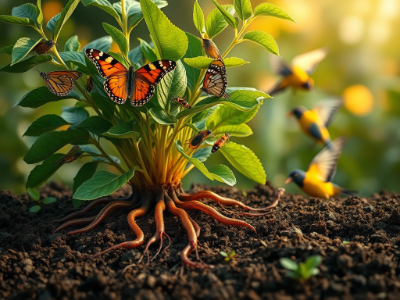
The sage knows that all living things are connected. Roots of a plant need rich soil to grow. Worms eat its roots while butterflies eat its leaves. Birds eat butterflies and animals eat plants. Humans eat all of these but eventually pass away and return to the soil.
The roots of Crow’s Feet turn into maggots, and their leaves turn into butterflies. Before long, the butterflies are transformed and turn into insects that live under the stove; they look like snakes, and their name is Qutuo. After a thousand days, the Qutuo insects become birds called Dried Leftover Bones.
Jiuyou bugs are born from Mourui bugs, and Mourui bugs are born from Rot Grubs, and Rot Grubs are born from Sheep’s Groom. Sheep’s Groom couples with bamboo that has not sprouted for a long while and produces Green Peace plants. Green Peace plants produce leopards, and leopards produce horses, and horses produce men. Men in time return again to the mysterious workings. So all creatures come out of the mysterious workings and go back into them again.”
Conclusion
What is happiness? Humanity values wealth, reputation, and power. However, these things do not guarantee happiness and can actually prevent it. Wealth brings a hectic life and worry about protecting possessions. The sage finds happiness in the state of Wu Wei or effortless action. They only take action after much reflection when it seems natural in the moment. The sage keeps life and death in proper perspective and realize that they are part of nature. Individuals have different needs due to their biology, but are still connected as part of nature.
Resource
Complete Works Of Chuang Tzu, Burton Watson, translator. Columbia University Press, 1968. A good and classic translation of Chuang Tzu.
 Daoism