
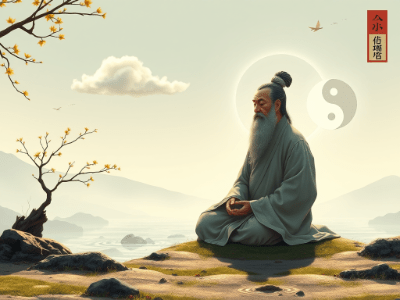
The book Zhuangzi is an essential text in Daoism. Chapter Twenty Six, External Things, rejects the human values of wealth, power, excess, and fame.
“[In man,] virtue spills over into a concern for fame, and a concern for fame spills over into a love of show. Schemes are laid in time of crisis; wisdom is born from contention; obstinacy comes from sticking to a position; government affairs are arranged for the convenience of the mob.”
Wealth
The sage rejects things that humanity values such as wealth. They see that external things do not bring happiness. Instead they focus on the internal and reaching a state of emptiness.
“External things cannot be counted on.”
“His mind is as though trussed and suspended between heaven and earth, bewildered and lost in delusion. Profit and loss rub against each other and light the countless fires that burn up the inner harmony of the mass of men.”
Power
The sage rejects power and leadership. They are content with their daily life.
“Now if you shoulder your pole and line, march to the ditches and gullies, and watch for minnows and perch, then you’ll have a hard time ever landing a big fish. If you parade your little theories and fish for the post of district magistrate, you will be far from the Great Understanding.”
Excess

The sage rejects accumulating possessions and excess. They live life sticking to the necessities.
“I heard someone calling me on the road. I turned around and saw that there was a perch in the carriage rut. I said to him, ‘Come, perch—what are you doing here?’ He replied, ‘I am a Wave Official of the Eastern Sea. Couldn’t you give me a dipperful of water so I can stay alive?’ I said to him, ‘Why, of course. I’m just about to start south to visit the kings of Wu and Yue. I’ll change the course of the West River and send it in your direction. Will that be all right?’ The perch flushed with anger and said, ‘I’ve lost my element! I have nowhere to go! If you can get me a dipper of water, I’ll be able to stay alive. But if you give me an answer like that, then you’d best look for me in the dried fish store!”
Fame
The sage rejects fame and does not value reputation. They remain humble and do not assume that they know what is right. They always reflect before taking action which makes success much more likely.
“These are the actions, the ‘progress’ of mediocre men—men who pull one another around with fame, drag one another into secret schemes, join together to praise Yao and condemn Jie, when the best thing would be to forget them both and put a stop to praise! The sage is hesitant and reluctant to begin an affair, and so he always ends in success. But what good are these actions of yours? They end in nothing but a boast!”
Knowledge

The sage knows the limit of human knowledge and does not feel the need to accumulate it. Instead they work towards emptiness and the unity of all things.
“So it is that knowledge has its limitations, and the sacred has that which it can do nothing about. Even the most perfect wisdom can be outwitted by ten thousand schemers. Fish do not [know enough to] fear a net but only to fear pelicans. Discard little wisdom, and great wisdom will become clear.”
Emptiness
The state of emptiness is seeing the connection of all things. The sage stays focused on the Way.
“Heaven opens up the passages and supplies them day and night without stop. But man, on the contrary, blocks up the holes. The cavity of the body is a many-storied vault; the mind has its Heavenly wanderings.“
This allows the sage to live in the world without becoming encumbered by it. The sage goes with the flow and does not force action. They accept the world for what it is.
“Only the Perfect Man can wander in the world without taking sides, can follow along with men without losing himself.”
“Therefore I say, the Perfect Man is never a stickler in his actions.“
In emptiness there is no agitation, trouble, or worry.
“Stillness and silence can benefit the ailing, massage can give relief to the aged, and rest and quiet can put a stop to agitation. But these are remedies that the troubled and weary man has recourse to. The man who is at ease does not need them and has never bothered to ask about them.”
In emptiness, one forgets skills, techniques, and human knowledge.
“The fish trap exists because of the fish; once you’ve gotten the fish, you can forget the trap. The rabbit snare exists because of the rabbit; once you’ve gotten the rabbit, you can forget the snare. Words exist because of meaning; once you’ve gotten the meaning, you can forget the words. Where can I find a man who has forgotten words so I can have a word with him?”
Conclusion
The sage rejects the human values of wealth, power, excess, and fame. They see that these external things do not bring happiness. They work towards emptiness and the connection of all things. This allows them to live the world without being bothered by it. They only act if necessary and after much reflection.
Resource
Complete Works Of Chuang Tzu, Burton Watson, translator. Columbia University Press, 1968. A good and classic translation of Chuang Tzu.
 Daoism