

The Liezi is considered the third most important text in Daoism (Taoism) after the Dao De Jing and Zhuangzi. Chapter five is named Questions of Tang.
The chapter includes mystical tales of immortal people, pearl forests, and gold buildings. Besides the fantastic imagery there is much about the sage and living according to the Dao.
The Dao
The Dao has no beginning and no ending.
“The endings and beginnings of things have always been infinite. A beginning may be an end, an end may be a beginning— how can that start be known? So what is outside of things, prior to events, is unknown to me.”
It is limitless and infinite.
“There is no limit to nothing, there is an end to the existent. How should I know? But there is no infinity outside the infinite, no endlessness inside the endless. The infinite has no infinity, and the endless has no endlessness.”
It makes up all things great and small. It includes heaven and earth and all beings within.
“Thus great and small contain each other, endlessly, ad infinitum. Containing all beings is like containing heaven and earth; containing all beings implies endlessness, containing heaven and earth implies infinitude.”
Uniqueness
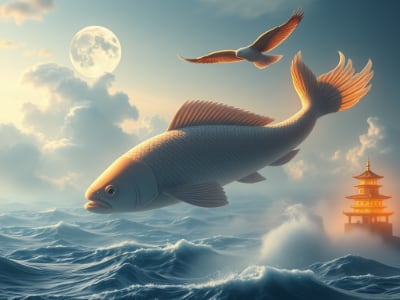
Some things are so vast that they defy imagination such as the massive bird Peng or the huge fish Kun which were also found in Zhuangzi, Chapter 1.
“North of the extreme north there is a vast ocean, which is the Lake of Heaven. There is a fish there thousand of miles wide and correspondingly long, called the kun. There is a bird there called the peng with wings like clouds covering the sky, and a body to match.”
Some things are so small that they can’t be seen.
“There is a minute insect called jiaoming that lives on the river banks. These can swarm onto the eyelash of a mosquito without bothering it. They remain residing there, coming and going, without the mosquito noticing.”
Regardless of their size, all things are equal and unique, important in their own right.
“Even so, though their forms and energies differ, they are equal in respect to nature, and not interchangeable. Their lives are complete in themselves, their lots are sufficient unto themselves.”
Single mindedness
The sage is singleminded and therefore can accomplish much.
“Children and grandchildren will continue to be born generation after generation, while the mountains will never grow larger—so why worry about not leveling the mountains?”
The sage is completely in the moment.
“It took me five years to master the method. When I am at the riverside holding my fishing pole, there are no random thoughts in my mind, only thought of fish; when I cast my line and sink my hook, there’s no resistance in my hands, so nothing can cause any disturbance.”
Adaptability
The sage adapts instantly to life’s challenges. They do not see events as good or bad but take life as it comes.
“What you feel in the bit, respond to with the bridle; what you feel in the bridle, respond to with your hands; what you feel in your hands, respond to in your mind. Then you don’t use your eyes to look, don’t use your whip to drive; your mind is at ease, your body’s upright, the six bridles don’t tangle, and twenty-four hooves don’t miss a step.”
Social Harmony
Living with the Dao means to be in equality and harmony with others. The sage is not arrogant, nor contentious, and lives a full life. They do not rule over others.
“The people were by nature genial and agreeable, not competitive or contentious. They had soft hearts and weak bones; they were not arrogant, not envious. Older and younger lived as equals, neither ruling nor subjected; males and females associated freely, without matchmaking or betrothal.”
The sage recognizes the relativity of different cultures and societies. They know that good and bad are often dependent on the person.
“People in southern countries cut their hair and go naked; people in northern countries wear turbans and leather garments; people in temperate countries wear hats and clothing of fabric. As for what the nine lands provide, some are agricultural, some commercial; some are hunters and some are fishers. Like wearing leather in winter and silk in summer, traveling by boat on water and by car on land, it goes without saying, turning out that way naturally.“
“Made into policies by rulers, these are made into customs by subjects, and so nothing to wonder at.”
Emptiness
The sage focuses on the inside in order to navigate the world. They seek a state of emptiness.
“By mastering it inwardly in the innermost mind, while outwardly according with the will of the horses, it is thus possible to go back and forth on a straight line, turn around with precision, and go long distances with energy to spare, having truly attained the art.”
Conclusion
The Dao is limitless and has no beginning. It makes up all things which are equal in the Dao.
The sage is singleminded and adapts to life. They live in harmony with others, are not arrogant, and do not rule others. They recognize the relativity of good and bad and focus on the internal in order to navigate the external world.
Resource
The Book of Master Lie, Thomas Cleary, translator. 2011. A nice translation of Liezi.
 Daoism