
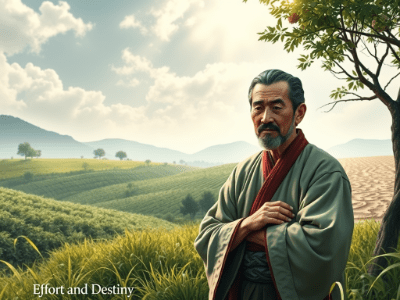
The Liezi is considered the third most important text in Daoism (Taoism) after the Dao De Jing and Zhuangzi. Chapter six is named Effort and Destiny and explores the impact of the Dao on our lives.
Success and Failure
A “sage” is one who lives their life according to the virtue of the Dao.
“Those who distribute virtue to others are called sages.”
They view the Dao as destiny and the way of nature. They know that things such as success and failure are based on the flow of nature and often out of their control.
“Beigongzi is rich in virtue, poor in fate; you are rich in fate poor in virtue. Your success is not obtained by wisdom, while Beigongzi’s failures are not by way of mistakes due to folly. Both are from Nature, not humankind.”
“Here are people quite similar in age, property, talent, and appearance, yet quite different in longevity, status, reputation, and inclination.”
“Fortuitous success seems like success but is not success at all. Fortuitous failure seems like failure, but is not failure at all.“
One should go along with nature just as farmers follow the seasons. A farmer might have a successful year based on the weather like a person might have a successful year based on the flow of the Dao.
“Farmers follow the seasons, merchants head for profit, artisans pursue skills, officials go after power. Conditions dictate this. However, farmers experience flood and drought, merchants may gain or lose, artisans may succeed or fail, officials may or may not get opportunities. Destiny dictates this.“
Life and Death

The sage recognizes that life and death are beyond their control. One doesn’t choose when they are born or when they die.
“One naturally lives long or naturally dies young.”
“But what gives life to the living and death to the dying is not a thing and not self; it is all destiny, about which intelligence can do nothing. So it is said, Mysterious and boundless, the course of Nature organizes itself; Silent and undivided, the course of Creation operates itself.”
One may die even if they value life. One may live even if they hate life.
“So you may not survive even if you value life, and may not die even if you despise it. This seems contradictory, but it is not; it’s a matter of living naturally and dying naturally, caring naturally and neglecting naturally. So it’s better not to look to the divine will and try to figure out gain and loss.”
People live their natural length of years and eventually the younger generation takes their place.
“With several lords to look after this, you then, my lord, would be standing in the fields in reed raingear, worried only about work—how would you have time to worry about death? “And how did you get your position anyway? Because of successive occupation and departure. Now that it’s come to you, for you to be the only one to weep over it is inhumane.”
Leadership

A leader who follows the Dao forgives the mistakes of others. They do not engage in endless blaming of others.
“He is so puritanical that he won’t associate with anyone unlike himself, and once he’s heard of a fault in a person he never forgets it all his life. If you let him administer the state, he’ Il be investigating the ruler above and imposing on the people below. It wouldn’t be long before he’d be punished by the ruler.”
A true leader is compassionate and inspires others. They are trusted by their superiors.
“He is the sort of man whom superiors forget about and inferiors do not disobey. He is ashamed of not being comparable to the Yellow Emperor, and feels compassion for those who are not comparable to him.”
A leader does not bully or criticize others. They know that this would be counterproductive and lead to a backlash.
“He repeatedly criticized Zichan’s administration, and Zichan yielded to him. Then Zichan had him arrested and disgraced, and summarily executed. So Zichan applied the criminal code, not because he could, but because he had to.
They never command others and always remain humble.
“Those who use sagacity to lord over others have never won people, while those who use sagacity to humble themselves to others have never failed to win people—regarding the state, there is that which they don’t hear; and regarding the home, there is that which they don’t see.“
Conclusion
The Dao can be seen as nature or destiny. It is best to flow with nature because success and failure, life and death, are often out of a person’s control. A leader acting in accordance with the Dao forgives others, is compassionate and inspirational. They are trusted, never bully others, and remain humble.
“So it is said that death and life come from destiny, poverty and riches depend on the times. Those who resent early death are those who do not know destiny; those who resent poverty are those who do not know the times.“
Resource
The Book of Master Lie, Thomas Cleary, translator. 2011. A nice translation of Liezi.
 Daoism