
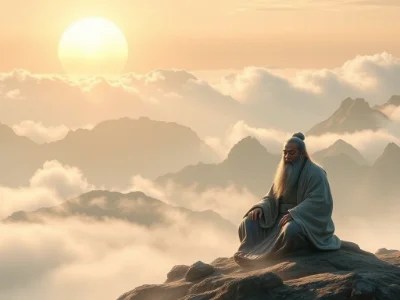
Some have named the Wenzi (Wen Tzu) the fourth most influential Daoist text after the Dao De Jing, Zhuangzi, and Liezi. However scholars have questioned its authenticity because it contains Confucian, Legalist, and Mohist philosophies. (Creativity and Intertextuality, pages 8, 23, 25, 32, 61-65, 81, and 84).
Chapter Two is named Sincerity and Virtue. Although it primarily includes Confucian philosophy there are some important Daoist teachings on flexibility, emptiness, effortless action, and leadership.
Dao
The Dao is formless and makes no sound. It unifies creation.
“The Way has no form or sound, so sages have deliberately depicted it as a unity and named it the Way of the universe.”
Flexibility
The sage is humble and focused on the internal. They do not show off their accomplishments. They are flexible by being willing to yield to others.
“Therefore sages inwardly cultivate the arts of the Way and do not put on an external show of humanitarianism and dutifulness. To know what is good for the senses and the body and roam in the harmony of the vital spirit is the roaming of the sage.”
Emptiness
The sage seeks emptiness and lets their mind merge with creation.
“As to the roaming of sages, they move in utter emptiness, let their minds meander in the great nothingness; they run beyond convention and go through where there is no gateway. They listen to the soundless and look at the formless“
They are not concerned with society’s definition of right and wrong.
“they are not constrained by society and not bound to its customs.”
The sage does not rely on logic and reason. Instead they focus on their inward connection to creation.
“So know the world without going out the door, know the weather without looking out the window; the further out it goes, the less knowledge is. This means that when pure sincerity emerges from within, spiritual energy moves in heaven.”
This passage appears to be heavily influenced by the Dao De Jing which states:
“Without stepping out the door, you can know the world. Without looking through the window, you can see Heaven’s Way. The longer you travel, the less you know.”
Dao De Jing, Chapter 47
Effortless Action

The sage rarely acts and is content with few possessions. In this way they accomplish what is needed without effort.
“Sages minimize their affairs, which are thus orderly. They seek to have little, and thus are sufficed; they are benevolent without trying, trusted without speaking. They gain without seeking, succeed without striving.“
They follow the Dao and the world responds to them.
“They take naturalness to heart, preserve ultimate reality, embrace the Way, and promote sincerity, so the whole world follows them as echoes respond to sounds, as shadows imitate forms. What they work on is the root.”
They act spontaneously going where they need to go and doing what needs to be done.
“All beings resort to the light of the winter sun and the shade of the summer sun, without anyone coercing them to do so. In an extremely natural way, by the sensitivity of ultimate vitality, they come without being called and go without being sent. It is a profound mystery, and no one knows what does it, but the effects develop spontaneously.”
Leadership
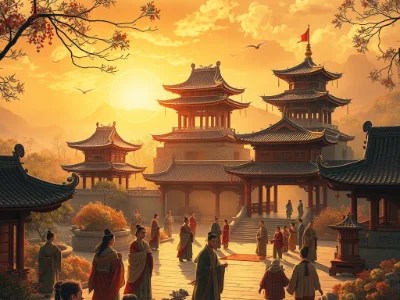
In a perfect society the strong do not exploit the weak, minorities are protected, and people live in harmony.
“In ancient times, when the Yellow Emperor governed the land…prevented the strong from overshadowing the weak, and saw to it that the majority did not harm minorities.“
The people live a long life and crops grow plentiful. Leaders are not biased and laws are clear and limited.
“The people lived out their lives and did not die prematurely, the crops ripened in season and did not fail. Officials were upright and unbiased, rulers and ruled were harmonious and had no resentments. Laws and directives were clear and not obscure, helpers were fair and not obsequious.“
This section is reminiscent of Chapter 2 of the Liezi in which the Yellow Emperor dreamt of Shagri-la where people lived in a state of nature and had long lives.
“Taking a nap one day, he dreamed he traveled to Shangri-la…In that country there were no political leaders, just a state of nature. The people had no habits or cravings, they were just natural. They didn’t know to like life or to detest death, so there was no premature death. They didn’t know to prefer themselves to others, so there was no love or hatred. They didn’t know how to rebel or obey, so there was no profit or harm. They had no attachments, so they had no fears.”
Liezi, Chapter 2
A leader does not command others or support repressive laws.
“They nurture the people fairly; authority is not commanding, the legal system is not complicated, education is spiritual. The laws are broad, the punishments easygoing, the prisons are empty. The whole land has the same mores, and no one harbors treachery at heart. This is the grace of sages.”
Conclusion
The Dao unifies all things yet is formless. The sage seeks connection with it by seeking a state of emptiness where they look inward and do not rely on logic or reason. They accomplish what is needed without effort and are spontaneous. In a perfect society the strong do not exploit the weak and people live in harmony. A true leader never commands others or supports repressive laws.
Resources
Wen-Tzu, Understanding the Mysteries, Thomas Cleary, Translator. 1991.
The Book of Master Lie, Thomas Cleary, translator. 2011.
Tao Te Ching: The Taoism of Lao Tzu Explained, Stefan Stenudd, author. CreateSpace Independent Publishing, 2nd edition 2015.
 Daoism