Dingzhou Wenzi Virtue

Some have named the Wenzi (Wen Tzu) the fourth most influential Daoist text after the Dao De JingZhuangzi, and Liezi. However, scholars have questioned its authenticity because it contains Confucianist, Legalist, and Mohist philosophies. In 1973, an early form of the Wenzi was discovered in Dingzhou, China (Creativity and Intertextuality, pages 8, 23, 25, 32, 61-65, 81, and 84).

Its teaching on virtue contradicts Daoist thought and is more consistent with a Confucianist approach.

Confucian Virtue

The Dingzhou Wenzi follows the Confucian teaching that a leader is the one who brings order to society.

It says a leader should possess the four qualities of virtue, compassion, propriety, and righteousness.

Under this hierarchical approach a leader should correct the people like a father corrects his children.

A leader is virtuous when they are not arrogant or heavy-handed.

If a leader remains virtuous, the people will enjoy success.

If a leader does not remain virtuous, the people will rebel or flee.

Daoist Virtue

Unlike Confucianism, a Daoist believes that a person does not need to deliberately try to be virtuous. This is because they automatically are by following the Dao. It is a byproduct of being in harmony with the Dao.

If a leader follows the Dao, then all things are taken care of and success follows. There is no need for a top down approach where a leader teaches propriety to the people. The leader simply gives people the freedom to follow the Dao themselves.

A leader does not need to correct the people because the people find their own harmony when they follow the Dao.

Conclusion

The Dingzhou Wenzi follows the Confucianist approach that a leader must be virtuous in order to have an ordered society. Under this hierarchical system, a leader must correct the people when they misbehave. This goes against Daoist teaching where one simply needs to follow the Dao and virtue and success follows. Under this more egalitarian approach a leader gives people the freedom to follow the Dao in their own lives and in doing so will find harmony.

Resources

The Wenzi: Creativity and Intertextuality in Early Chinese Philosophy (Studies in the History of Chinese Texts, 9), Paul Van Els, Brill Academic Publisher, 2018. Quotes taken from this source found on pages 26, 50, 69-70, 89-92

Els, P. van. (2006, May 29). The Wenzi: creation and manipulation of a Chinese
philosophical text. Retrieved from https://hdl.handle.net/1887/4428.


Zhuangzi Chapter 5: Sign of Virtue Complete

Master Zhuang is the second most influential writer in Daoism (Taoism) and the book Zhuangzi was named after him. Chapter Five is The Sign of Virtue Complete and describes what a sage looks like who is in a state of virtue.

Interconnectedness

One enters this state when they shift their perspective to be in harmony with the Dao.

They can be in harmony by viewing all of creation as interconnected. The Dao becomes a guide and one sees the unity of all things.

Admit Faults

Those approaching virtue admit to their faults and do not make excuses for their past behavior. They do not care for fame or reputation.

In the Moment

They are focused on the moment and do not allow joy or sorrow to affect them. They simply let things be as they are.

They make no plans and do not allow loss to affect them. They do not care for profit, but only are concerned with being in harmony with the Dao.

The Body

If someone has virtue the body is unimportant. It does not matter if someone is ugly, poor, or powerless. A man of virtue named Ai Taituo was considered ugly and was not powerful or wealthy. However, women wanted to be near him and the rich wanted him to run their estates.

Physical disabilities or limitations are unimportant. The body is simply seen as a dwelling.

Life and Death

In this state one is unconcerned about life and death or the events of the day. The world could come to an end and it would not affect them.

They do not fear death but see life and death as part of the Dao. Wang Tai was in virtue and many wanted to be his disciples. It didn’t matter that he had been a criminal or that he didn’t formally teach.

Conclusion

The Sage is one who is in a state of virtue. One enters this state when they are in harmony with the Dao and view all of creation as interconnected. They can admit their faults and do not care for fame or wealth. They live in the moment and do not allow sorrow to affect them. It doesn’t matter if the person is ugly, poor, or without power. They are not concerned with death and see the body as a dwelling.

Zhuangzi Chapter 4: In the World of Men

Master Zhuang is the second most influential writer in Daoism (Taoism) and the book Zhuangzi was named after him. Chapter Four is In the World of Men and teaches how to reform someone without virtue.

Reforming One without Virtue

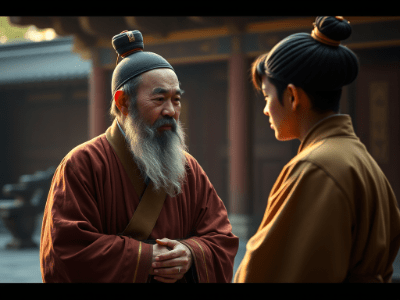
The Zhuangzi used historical figures such as Confucius to teach about the Dao. Yan Hui asked Confucius for permission to go to Wei to reform a violent ruler. Confucius advised against going, warning that he likely would be killed.

If he was fortunate enough not to be executed, he would probably still fail. Rulers are experts at bringing others to their side and can convince others to support them. Besides, one should be sure they have virtue in themselves before you try to reform others.

Yan Hui asked if he could reform the ruler by being resolute. Confucius responded that the ruler may make outward signs of reform but would never truly do so.

Not giving up easily, Yan Hui suggested outwardly agreeing with the ruler but remaining inwardly resolute. He could quote the words of historical teachers. Confucius responded, that he may avoid punishment, but would still not convert the tyrant.

The Daoist Approach

The Daoist approach to reform others is to be resolute inwardly and follow your own way. Don’t be motivated by fame or look for personal gain. Forget ego and be in a state of emptiness. Give the person advice only if they are willing to listen, otherwise remain silent.

Yan He wanted to reform the prince of Wei. Ju Boyu advised him to support the prince’s actions outwardly, but to be careful not to get drawn into his actions so much as be condemned by others.

The Ambassador

Ambassador Zigao of She asked Confucius for advice on his upcoming mission. Confucius reminded Zigao of the two great decrees: the duty to parents and to the nation. However, the greatest virtue is not to allow outside factors to affect your personal way and accept that there are things that you can not change.

Confucius went on to give advice on being a messenger. A messenger feels pressure to please both sides by exaggerating the positives. Exaggeration is irresponsible and reduces credibility. Inaccurate words can put the messenger in danger.

The messenger should never go beyond their orders or press too hard for agreement. A lasting agreement takes time and a bad agreement is hard to change. One should accept what you can’t change and focus on your own personal way.

Usefulness

Trees feature prominently in Daoist thought. The carpenter Shi went to Qui and saw an enormous oak tree with its lowest branches 80 feet off the ground. He called the tree worthless because it could not be used for timber, boats, or doors. Shi had a dream where the Oak tree visited saying it was not useless because it sheltered hundreds of people. Besides, “useful” trees do not get to live out their normal lifespan because they are cut down prematurely.

In a similar episode, Ziqi of Nanbo saw a large tree in which thousands of horses could take shelter. Even though its gnarled and pitted limbs made it “useless” as timber, it was used by Holy Men for gatherings.

A disabled man named Shu had a twisted body and could not stand straight. He survived by washing other people’s clothes and getting handouts. In-spite of his physical disabilities he got by and lived out his normal years. He avoided conscription by the army and his physical disability paled in comparison to a disability of virtue.

Finally, Jie Yu was called the madman of Chu because he would cry out in public that the past was gone and the future would never arrive. The sage succeeds with the Dao and simply survives without it. No one can truly know the usefulness of something.

Conclusion

Trying to reform others can be dangerous and lead to failure. One must be sure in their own virtue before reforming others. The best approach is to be inwardly resolute and following your own personal way. Don’t be motivated by fame and only give advice if the other person is willing to listen.

A messenger should never exaggerate or press for an agreement. Twisted trees may appear useless but often have an unforeseen purpose living out its normal years. Twisted virtue is much worse than having a twisted body.

Confucianism and Buddhism

The three teachings of Eastern Asia include Daoism (Taoism), Confucianism, and Buddhism. Each can be better understood by contrasting them with the other.

Confucianism

Confucianism stresses obedience to authority because Confucius saw that people needed guidance to avoid immorality. Confucius came up with many guidelines for people to live by to have a structured and prosperous society. Much of this centers on respect for parents and elders.

Daoism

Daoism teaches that the Dao (Tao) or “Way” creates and guides the universe. Laozi (Lao Tzu) said life is much more satisfying if one follows the natural state of the Dao using meditation. This includes constant change due to the opposing forces of Yin and Yang. There is no sweet without the sour. Authorities should be hesitant to act and only do the minimum amount so as to not upset the natural balance.

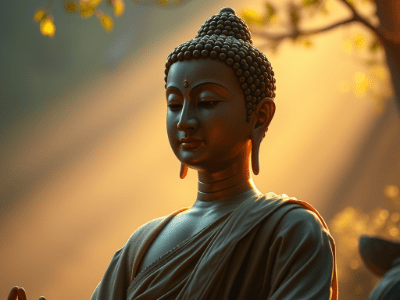
Buddhism

Buddhism teaches that life is suffering because people are attached to their possessions and desires. Similar to Daoism it involved meditation to find inner peace and to follow the Eight Fold Path of right speech, action, livelihood, effort, and mindfulness. Eventually, one can reach a state of Nirvana or “state of peace” and become enlightened breaking out of a constant cycle of rebirth.

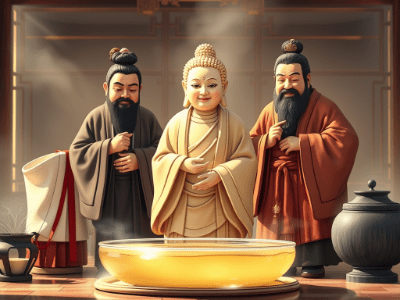
The Three Vinegar Tasters

These beliefs can be contrasted by the parable of the Three Vinegar Tasters. Confucius, Buddha and Laozi put their finger in a vat of vinegar to taste it. Confucius reacts with a sour face, Buddha reacts with a bitter face, but Laozi reacts with a happy face (Wikipedia, Vinegar Tasters).