
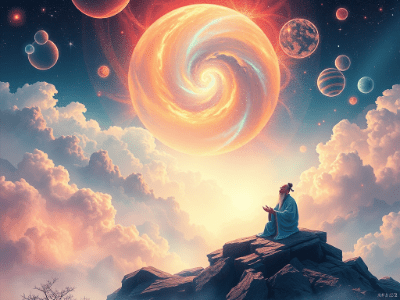
The Liezi is considered the third most important text in Daoism (Taoism) after the Dao De Jing and Zhuangzi. Chapter one is named Celestial Signs and focuses on concepts such as life, death, change, and happiness.
Creation
The Dao existed before all off creation.
“Therefore it is said that there was a cosmic evolution, a cosmic origin, a cosmic beginning, and a cosmic elemental. In the cosmic evolution, energy is not yet manifest.”
It gave form to all things. It creates energy, form, and substance.
“The cosmic origin is the beginning of energy. The cosmic beginning is the beginning of form. The cosmic elemental is the beginning of substance.”
The Dao unifies all things.
“When energy, form, and substance are all present yet not separated, that is called the undifferentiated, meaning that myriad things are mutually undifferentiated and not yet separate from one another.”
Change
While it unifies all things, it creates constant change. Beings are unborn, then born, constant, and then change.
“There is that which is born and that which is unborn; there is that which changes and that which is unchanging. The unborn gives birth to that which is born; the unchanging produces change.”
“From birth until death, there are four major changes in people: childhood, youth, old age, death.”
“A person’s body and mind differ every day, while skin, nails, and hair are shed as they grow. There is ceaseless change from infancy on; one is not aware of it while it’s going on, but only realizes after it’s happened.”
It causes the variation of sound, color, and flavor.
“There is sound, and there is that which makes sound sound; there is color, and there is that which colors color. There is flavor, and there is that which flavors flavor.”
No Limitation

The Dao accomplishes nothing yet everything gets done. There is nothing it can’t do or doesn’t know.
“It has no knowledge and no ability, yet there is nothing it does not know, nothing it cannot do.”
It is responsible for both heaven and earth. Heaven creates life while earth supports it.
“Therefore heaven’s job is to create and to cover, earth’s job is to form and support, sages’ job is to teach and civilize, everyone’s job is what they’re suited for.”
Happiness
The sage is content with their life and happy with their existence.
“I have many reasons for happiness. Heaven gives birth to myriad beings, but humans alone are noble; I am human, so I’m happy. Some babies are stillborn, some die in infancy;”
The sage stays content in old age.
“I am already ninety years old, death is the end for people; awaiting death in a normal state, what should I be melancholy about?”
“The fact that I’m growing old without wife or children and am soon going to die is why I can be so happy.”
The sage is content in poverty.
“The reasons for my happiness are available to everyone, but they take them for misery instead. The fact that I didn’t work hard when young and didn’t compete with contemporaries as I matured is why I have lived so long.”
The sage doesn’t fear the unknown or worry about the future.
“It’s wrong to say the universe will disintegrate, and it’s also wrong to say the universe will not disintegrate. Whether or not it will disintegrate is something one cannot know. So while alive we don’t know death, and when dead we don’t know life. How can I concern myself with whether or not the universe will disintegrate?”
Life
The sage knows that life is a gift of the Dao.
“It is a form entrusted by the universe. Life is not our possession; it is a harmony entrusted by the universe. Nature and destiny are not your possessions; they are order entrusted by the universe.”
The sage knows that life is supported by the Dao.
“I have heard that heaven has seasons, earth has yields. I steal the seasonal yields of heaven and earth, the moisture of clouds and rain, the fertility of mountains and wetlands, to grow my grain, plant my crops, construct my fences, and build my house. On land I steal birds and beasts, from the water I steal fish and turtles. It’s all stealing! Crops, earth and wood, birds and beasts, fish and turtles, are all produced by heaven—how could they belong to me? Yet I steal from heaven with impunity.”
Death
The sage doesn’t view death as an end or something to fear.
“Death and birth are a round-trip, so when I die here, how do I know I won’t be born elsewhere? So how do I know they’re not equivalent? And how do I know it’s not delusion to strive for life? And how do I know my death now will not be better than my life in the past?”
“People all know the pleasure of life but not the pain of life; they know the fatigue of old age, but not the freedom of old age; they know the horror of death but not the peace of death.”
They know that all things eventually return to the Dao.
“People eventually resolve into elements; all things and all beings come from elements and all go back to elements.”
“Death is a return of virtue; the ancients referred to the dead as people who have returned.”
No one knows if death is truly the end.
“Do heaven and earth end? Along with us, they come to an end. Is the end final? I don’t know. The Tao ends in basic beginninglessness, it reaches finality in original impermanence. What is born returns to an unborn state, what has form returns to a formless state.”
Conclusion
The Dao has always existed and gave form to all things. It creates endless change. It accomplishes all things yet does nothing. The sage finds happiness in all stages of life including birth, childhood, old age, and poverty. They see life as a gift and do not view death as a true end but a return to the Dao.
Resource
The Book of Master Lie, Thomas Cleary, translator. 2011. A nice translation of Liezi.



 Daoism