
Wenzi Chapter 1: The Origin of the Way

Some have named the Wenzi (Wen Tzu) the fourth most influential Daoist text after the Dao De Jing, Zhuangzi, and Liezi. However scholars have questioned its authenticity because it contains Confucian, Legalist, and Mohist philosophies. (Creativity and Intertextuality, pages 8, 23, 25, 32, 61-65, 81, and 84).

Chapter One is named The Origin of the Way and discusses the mystery that is the Dao along with flexibility, effortless action, and emptiness.

The Dao

The Dao was in existence before creation. Existence came out of non-existence.

It has no form and makes no noise.

Although it is formless it creates sounds, colors, and flavors.

It manifests itself through nature and creates harmony between light and dark, large and small, flexibility and firmness.

It is found in all existence and unifies all things.

Flexibility

The sage is one who follows the way. A sage follows the way by being flexible and yielding. A sage is willing to change course based on the circumstances.

They never act in preconditioned patterns but instead react to circumstances. This allows one to be successful and avoid harm.

The sage remains humble and knows that humility allows them to overcome obstacles in their life.

By remaining humble they protect themselves because others are not threatened by them.

Life is flexible while death is inflexible.

Emptiness

A person is born into a state of emptiness but over time they become uncentered due to their experiences.

The sage seeks to return to this state where one has a clear mind, accepts their situation, and remains calm.

In this state the sage is not affected by desire or struggles in life. They are not distracted by sorrow or joy.

In emptiness one has inner balance and harmony.

They are formless and merge with the world.

True happiness is found in emptiness and harmony. It is not found in wealth or status.

Effortless Action

The sage doesn’t act rashly from a state of emptiness.

Instead they respond to their environment.

They only act when it is the right time.

They do not act based on logic, strategy, reason, or education.

Leadership

A true leader follows the Dao and acts in accordance with nature.

They do not rely on logic and are not arrogant nor cunning.

They give people freedom to be themselves and do not strive for power.

The sage does not wish to govern others but focuses inward on their connection to the Dao.

Conclusion

The Dao is formless and manifests itself in nature. It creates harmony and unifies all things. The sage follows the way by being flexible, yielding, and humble. The sage seeks the state of emptiness where one has a clear mind, accepts their situation, and remains calm. They are not affected by desire and are formless merging with the world. In this state, the sage acts effortlessly by responding to their environment at the right time. A true leader follows the Dao and gives people freedom to be themselves.

Consider how water is the softest element yet can’t be hurt, wounded, or burned. It is strong enough to penetrate any substance.

It is flexible in both its shape and purpose. It can be rain, dew, rivers, or lakes.

Water embraces all life without bias.

Resources

Wen-Tzu, Understanding the Mysteries, Thomas Cleary, Translator. 1991.

Dingzhou Wenzi Virtue

Some have named the Wenzi (Wen Tzu) the fourth most influential Daoist text after the Dao De JingZhuangzi, and Liezi. However, scholars have questioned its authenticity because it contains Confucianist, Legalist, and Mohist philosophies. In 1973, an early form of the Wenzi was discovered in Dingzhou, China (Creativity and Intertextuality, pages 8, 23, 25, 32, 61-65, 81, and 84).

Its teaching on virtue contradicts Daoist thought and is more consistent with a Confucianist approach.

Confucian Virtue

The Dingzhou Wenzi follows the Confucian teaching that a leader is the one who brings order to society.

It says a leader should possess the four qualities of virtue, compassion, propriety, and righteousness.

Under this hierarchical approach a leader should correct the people like a father corrects his children.

A leader is virtuous when they are not arrogant or heavy-handed.

If a leader remains virtuous, the people will enjoy success.

If a leader does not remain virtuous, the people will rebel or flee.

Daoist Virtue

Unlike Confucianism, a Daoist believes that a person does not need to deliberately try to be virtuous. This is because they automatically are by following the Dao. It is a byproduct of being in harmony with the Dao.

If a leader follows the Dao, then all things are taken care of and success follows. There is no need for a top down approach where a leader teaches propriety to the people. The leader simply gives people the freedom to follow the Dao themselves.

A leader does not need to correct the people because the people find their own harmony when they follow the Dao.

Conclusion

The Dingzhou Wenzi follows the Confucianist approach that a leader must be virtuous in order to have an ordered society. Under this hierarchical system, a leader must correct the people when they misbehave. This goes against Daoist teaching where one simply needs to follow the Dao and virtue and success follows. Under this more egalitarian approach a leader gives people the freedom to follow the Dao in their own lives and in doing so will find harmony.

Resources

The Wenzi: Creativity and Intertextuality in Early Chinese Philosophy (Studies in the History of Chinese Texts, 9), Paul Van Els, Brill Academic Publisher, 2018. Quotes taken from this source found on pages 26, 50, 69-70, 89-92

Els, P. van. (2006, May 29). The Wenzi: creation and manipulation of a Chinese
philosophical text. Retrieved from https://hdl.handle.net/1887/4428.

Dingzhou Wenzi – Dao

Some have named the Wenzi (Wen Tzu) the fourth most influential Daoist text after the Dao De Jing, Zhuangzi, and Liezi. Although scholars have questioned its authenticity because it contains Confucian, Legalist, and Mohist philosophies. In 1973, an early form of the Wenzi was discovered in Dingzhou, China (Creativity and Intertextuality, pages 8, 23, 25, 32, 61-65, 81, and 84).

It was organized around a series of questions between King Ping and his advisor Wenzi and includes themes such as the Dao, flexibility, wu wei, and leadership which are consistent with Daoist philosophy.

Leadership

A leader faces many challenges in an ever changing world.

Therefore they should follow the way.

If a leader does not follow the way they will face failure. If they do they will be more likely to succeed.

Effortless Action

If one follows the way they do not take action unless it is aligned with the way. By forcing action or insisting on taking a certain action one faces failure.

Flexibility

A leader is flexible and adjusts to the moment. They are aware of changes and react to them in the moment.

A leader is not heavy handed and does not rely overly on punishment. Instead they take action according to the way.

They do not rely on violence and are not arrogant in their leadership.

A leader remains humble and does not claim great authority. By being humble they may accomplish much.

A leader should look to nature as an example on how to act. A river flows to the lowest points and flows around obstacles. In the same way the leader should be humble, restrained, and yielding.

Conclusion

A leader should act according to the way in order to deal with a chaotic world. They do not force action and remain flexible. They do not rely on violence or become arrogant. Instead they act like a river that flows to the lowest point and around obstacles. A leader stays humble, restrained, and yielding.

Resources

Daoism Books Now Available

Daoism An Ancient Philosophy for the Modern Age

Daoism: The Fundamental Texts

This book summarizes the three great texts of Daosim: the Dao De Jing, Zhuangzi, and Liezi. It analyzes chapters, highlights key quotes, and provides the author’s interpretation and commentary. These texts form the backbone of Daoist philosophy and helps one find their place in the universe. They provide practical advice on how to live life, reduce stress, and be in the moment.

This is an alternative to my earlier book, Daoism: An Ancient Philosophy for the Modern Age, which was organized by the themes of constancy, compassion, flexibility, usefulness, Yin-Yang, wu wei, success, happiness, leadership, and emptiness. Both of these books share much of the same material, quotes, images, and interpretations but are organized differently. The reader can choose which approach they prefer or read both for different perspectives.

Available on Apple Books and Amazon.

About the Author

Brian Gentile is a multifaceted individual whose diverse expertise spans several fields, including history education, martial arts, and philosophy. With a strong academic foundation, holding a J.D. and M.Ed. from The Ohio State University, Gentile approaches topics with a rigorous and analytical mindset. His passion for learning drives him to conduct extensive research, enabling him to share well-informed insights with his audience. As an author, he communicates complex ideas in an accessible manner, fostering a deeper understanding of the subjects he explores. Gentile’s commitment to education and personal growth reflects his dedication to not only expanding his own knowledge but also enriching the lives of those eager to learn from his findings.

Liezi Chapter 8: The Tally of the Teaching

The Liezi is considered the third most important text in Daoism (Taoism) after the Dao De Jing and Zhuangzi. Chapter eight is named The Tally of the Teaching and focuses on living in accordance with the Dao.

Emptiness

The sage focuses on the internal in order to be in accordance with the Dao. They try to reach a state of emptiness.

Wu Wei

The sage recognizes the superiority of nature. They see themselves as part of nature and not above it.

They know that it is best to align their actions with nature by being in the moment and going with the flow. This Wu Wei or “effortless action” exerts less energy and causes one to be more successful.

They know that it is often better to take no action.

Events that seem negative can turn out to be positive in the long run.

External Things

The sage does not allow external things such as wealth, power, knowledge, or reputation distract them. They are not concerned with profit because it leads to conflict.

They know that status causes envy, power causes dislike, and wealth causes resentment.

The sage remains humble.

The sage avoids things that are valued.

A sage does not concern themself with reputation.

Leadership

A sage recognizes their own limitations and delegates important tasks to others.

In order to lead, one must be personally orderly.

They should be humble, detailed, and benevolent.

Conclusion

The sage focuses on the internal and reaching a state of emptiness. They are part of nature and engage in Wu Wei to flow with nature. This exerts less energy and causes one to be more successful. They know that it is often better to take no action.

The sage ignores external distractions such as wealth, power, knowledge, and reputation. They know that status and wealth cause envy. A leader should recognizes their limitations, delegate to others, and remain orderly on the inside.

Resource

The Book of Master Lie, Thomas Cleary, translator. 2011. A nice translation of Liezi.

Liezi Chapter 7: Yang Zhu

The Liezi is considered the third most important text in Daoism (Taoism) after the Dao De Jing and Zhuangzi. Chapter seven is named Yang Zhu and focuses on living in the moment.

Reputation, fame, and status

The sage does not worry about external factors such as reputation, fame, or status.

They know that reputation does not reflect reality. One may live generously but only have a good reputation after they die. One may live indulgently, but have a bad reputation after they die.

Fame and status are also artificial and have no lasting benefit.

Wealth

The sage knows that striving for wealth makes one unfulfilled.

The physical body is also a possession which one should not become attached.

It doesn’t matter if one values life, they will still die at their natural time. There is no point in worrying about death.

Worrying about a long life, fame, status, or wealth causes unneeded stress.

The future

The sage does not concern themselves with the future.

They don’t concern themselves with what happens after death.

Emptiness

The sage focuses on the internal by seeking a state of emptiness. This allows one to be a peace with the world.

They cultivate humility, generosity, and compassion.

Present moment

The sage finds contentment in the present moment.

The sage knows that the present moment is precious and fleeting.

Conclusion

The sage does not worry about the external. Reputation, status, fame and wealth are all artificial and leaves one unfulfilled. They do not concern themselves with the future because it creates unneeded anxiety.

Instead the sage focuses on the internal and seeks a state of emptiness. They are humble, generous, and compassionate and find contentment in savoring the present moment. One should surround themselves with pleasant sounds, environments, smells, and express themselves freely.

Resource

The Book of Master Lie, Thomas Cleary, translator. 2011. A nice translation of Liezi.

Liezi Chapter 6: Effort and Destiny

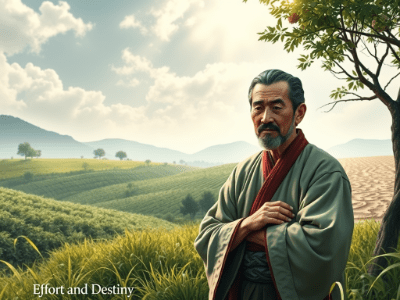
The Liezi is considered the third most important text in Daoism (Taoism) after the Dao De Jing and Zhuangzi. Chapter six is named Effort and Destiny and explores the impact of the Dao on our lives.

Success and Failure

A “sage” is one who lives their life according to the virtue of the Dao.

They view the Dao as destiny and the way of nature. They know that things such as success and failure are based on the flow of nature and often out of their control.

One should go along with nature just as farmers follow the seasons. A farmer might have a successful year based on the weather like a person might have a successful year based on the flow of the Dao.

Life and Death

The sage recognizes that life and death are beyond their control. One doesn’t choose when they are born or when they die.

One may die even if they value life. One may live even if they hate life.

People live their natural length of years and eventually the younger generation takes their place.

Leadership

A leader who follows the Dao forgives the mistakes of others. They do not engage in endless blaming of others.

A true leader is compassionate and inspires others. They are trusted by their superiors.

A leader does not bully or criticize others. They know that this would be counterproductive and lead to a backlash.

They never command others and always remain humble.

Conclusion

The Dao can be seen as nature or destiny. It is best to flow with nature because success and failure, life and death, are often out of a person’s control. A leader acting in accordance with the Dao forgives others, is compassionate and inspirational. They are trusted, never bully others, and remain humble.

Resource

The Book of Master Lie, Thomas Cleary, translator. 2011. A nice translation of Liezi.

Liezi Chapter 5: Questions of Tang

The Liezi is considered the third most important text in Daoism (Taoism) after the Dao De Jing and Zhuangzi. Chapter five is named Questions of Tang.

The chapter includes mystical tales of immortal people, pearl forests, and gold buildings. Besides the fantastic imagery there is much about the sage and living according to the Dao.

The Dao

The Dao has no beginning and no ending.

It is limitless and infinite.

It makes up all things great and small. It includes heaven and earth and all beings within.

Uniqueness

Some things are so vast that they defy imagination such as the massive bird Peng or the huge fish Kun which were also found in Zhuangzi, Chapter 1.

Some things are so small that they can’t be seen.

Regardless of their size, all things are equal and unique, important in their own right.

Single mindedness

The sage is singleminded and therefore can accomplish much.

The sage is completely in the moment.

Adaptability

The sage adapts instantly to life’s challenges. They do not see events as good or bad but take life as it comes.

Social Harmony

Living with the Dao means to be in equality and harmony with others. The sage is not arrogant, nor contentious, and lives a full life. They do not rule over others.

The sage recognizes the relativity of different cultures and societies. They know that good and bad are often dependent on the person.

Emptiness

The sage focuses on the inside in order to navigate the world. They seek a state of emptiness.

Conclusion

The Dao is limitless and has no beginning. It makes up all things which are equal in the Dao.

The sage is singleminded and adapts to life. They live in harmony with others, are not arrogant, and do not rule others. They recognize the relativity of good and bad and focus on the internal in order to navigate the external world.

Resource

The Book of Master Lie, Thomas Cleary, translator. 2011. A nice translation of Liezi.

Liezi Chapter 4: Confucius

The Liezi is considered the third most important text in Daoism (Taoism) after the Dao De Jing and Zhuangzi. Chapter four is named Confucius and rejects external praise while focusing on internal truth.

Acceptance

The sage knows that social rules or customs are not the way to the Dao. Instead the sage accepts life as it comes with no preconditions.

The sage strives to be compassionate, adaptable, reflective, and reserved.

Profit and Loss

The sage does not care about praise or condemnation.

The sage does not worry about gain or loss.

They accept both life and death.

In this way pain, punishment, and loss have no effect.

Influence and Leadership

The sage influencers others without governing them.

Those who lead with power or control are not true leaders. They are ignorant of leadership and incompetent.

Emptiness

The sage does not rely on the five senses, but instead strives for a state of emptiness. The mind, body, and spirit become one with the Dao.

“Don’t dwell on yourself, and things will be clear. Like water in movement, like a mirror in stillness, like an echo in response, the Way is thus in harmony with people.”

Travel is not taking a journey, but is a focus inward seeking emptiness.

The sage opens themselves up to the universe. They are not aware of their own thoughts, actions, or speech.

Always Alive

The Dao is responsible for all creation.

One can achieve eternity when they are with the Dao. Even though their life ends it doesn’t truly perish.

Conclusion

The sage knows that artificial rules are unimportant. One should accept what comes. The sage is compassionate and does not seek praise.

They influence others but do not command. They strive for emptiness where mind and body become one. The Way is responsible for all creation and though life ends, it doesn’t truly perish.

Resource

The Book of Master Lie, Thomas Cleary, translator. 2011. A nice translation of Liezi.

Liezi Chapter 3: King Mu of Zhou

The Liezi is considered the third most important text in Daoism (Taoism) after the Dao De Jing and Zhuangzi. Chapter three is named King Mu of Zhou and focuses on harmony and perspective.

Creation

The sage recognizes that the Dao is responsible for creation. This process is too complex to truly understand so we label it Dao for convenience sake.

Yin and yang creates change in creation and is easier to notice.

Yin and yang are responsible for important events such as birth, growth, happiness, and death.

They seek balance and results in differences in temperature, light, intelligence, strength, and wakefulness.

Reality

The sage recognizes that life and death are both aspects of creation.

Dreams and wakefulness are also aspects of creation.

Moderation

The sage strives for moderation which includes finding the proper work life balance. Working too hard causes exhaustion.

Forcing others to work too hard will also lead to unbalance. Mr. Yin was a businessman who worked his employees too hard.

In the Moment

The sage stays in the moment and doesn’t worry about the future or regret the past. Huazi of Song had short term memory. His family sought help and he was eventually cured.

Perspective

The sage never assumes they are right and recognizes the perspectives of others. Mr. Pang’s son has a condition where he saw everything backward. What was white was black and hot was cold.

The sage acknowledges that perception shapes reality. They are always willing to see things from another’s perspective.

Conclusion

While the sage doesn’t understand the Dao, they realize it is responsible for creation. Yin and yang create change and seeks balance. Life, death, reality, and dreams are all aspects of the Dao.

Moderation is a way to find harmony and includes finding a good work life balance. The sage stays in the moment and does not regret the past or worry about the future. They never assume they are right and consider the perspectives of others. They understand that perception defines reality.

Resource

The Book of Master Lie, Thomas Cleary, translator. 2011. A nice translation of Liezi.