
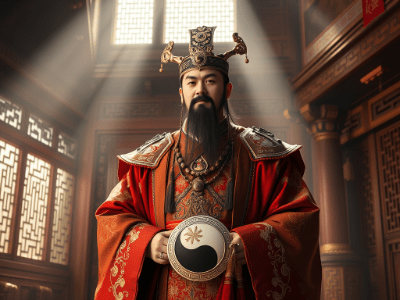
The Liezi is considered the third most important text in Daoism (Taoism) after the Dao De Jing and Zhuangzi. Chapter three is named King Mu of Zhou and focuses on harmony and perspective.
Creation
The sage recognizes that the Dao is responsible for creation. This process is too complex to truly understand so we label it Dao for convenience sake.
“The agency of Creation is subtle in its skill, profound in its effect, certainly hard to fathom, hard to comprehend.”
Yin and yang creates change in creation and is easier to notice.
“Working on form is obvious in its skill, shallow in its effect, so it readily appears and disappears.”
Yin and yang are responsible for important events such as birth, growth, happiness, and death.
“What are the eight manifestations of consciousness? Purpose, action, gain, loss, sadness, happiness, birth, and death.”
They seek balance and results in differences in temperature, light, intelligence, strength, and wakefulness.
“There yin and yang are precisely regular, so cold and heat alternate; dark and light are clearly divided, so day and night alternate. Some of the people there are intelligent, some are foolish.”
“Alternatively waking and sleeping, they consider their doings while awake to be real and their perceptions while dreaming to be illusion.”
Reality

The sage recognizes that life and death are both aspects of creation.
“What Creation initiates and what yin and yang transmute is said to be born and said to die. What is altered in terms of form by finding out processes and understanding change is said to be a transformation and said to be illusory.”
Dreams and wakefulness are also aspects of creation.
“’Earlier a woodcutter dreamed he’d caught a deer but didn’t know where it was; now I’ve found it, so that must have been a true dream!’ His wife said, ‘Could it be that you dreamed you saw a woodcutter catching the deer? Was there even a woodcutter? Now you’ve actually found a deer—does this mean your dream was true?’ Her husband said, ‘If that’s how I found the deer, what does it matter if it was the dream of another or my own dream?’”
Moderation
The sage strives for moderation which includes finding the proper work life balance. Working too hard causes exhaustion.
“By day he did his tasks groaning and grunting, while at night he slept soundly, completely worn out. As his consciousness dissolved, every night he’d dream he was ruler of a nation, reigning over the people, in charge of the affairs of the nation. Partying in palaces, indulging in his heart’s desires, he was incomparably happy.”
Forcing others to work too hard will also lead to unbalance. Mr. Yin was a businessman who worked his employees too hard.
“Every night he dreamed he was a servant, running all sorts of errands and doing all sorts of chores, repeatedly hollered at and beaten with a stick. In his sleep he muttered, groaned, and grunted all night long.”
In the Moment

The sage stays in the moment and doesn’t worry about the future or regret the past. Huazi of Song had short term memory. His family sought help and he was eventually cured.
“Before, when I was forgetful, I was serenely unaware of whether heaven and earth existed or not. Now that I am suddenly conscious of the past, I’m upset by the survival and passing, the gain and loss, the sorrow and joy, the liking and disliking, of several decades past; I’m afraid that future survival and passing, gain and loss, sorrow and joy, liking and disliking, will disturb my mind like this—can I even have a moment of forgetfulness?”
Perspective
The sage never assumes they are right and recognizes the perspectives of others. Mr. Pang’s son has a condition where he saw everything backward. What was white was black and hot was cold.
“How do you know your son is confused? Nowadays everyone in the world is confused about right and wrong, blind about what is beneficial and what is harmful. There are so many with the same affliction that no one realizes it.”
“If everyone in the world had a mind like your son, then you would be the one who’s confused.”
The sage acknowledges that perception shapes reality. They are always willing to see things from another’s perspective.
“Then they pointed to a shrine and said, ‘This is your village shrine.’ The old man sighed. Then they pointed to a house and said, ‘This was your ancestors’ abode.’ Now he wept profusely. They pointed out a mausoleum and said, ‘There are your ancestors’ tombs.’ The man wailed uncontrollably. His fellow travelers laughed and said, “We were fooling you—this is still only the country of Jin.”
Conclusion
While the sage doesn’t understand the Dao, they realize it is responsible for creation. Yin and yang create change and seeks balance. Life, death, reality, and dreams are all aspects of the Dao.
Moderation is a way to find harmony and includes finding a good work life balance. The sage stays in the moment and does not regret the past or worry about the future. They never assume they are right and consider the perspectives of others. They understand that perception defines reality.
Resource
The Book of Master Lie, Thomas Cleary, translator. 2011. A nice translation of Liezi.



 Daoism