
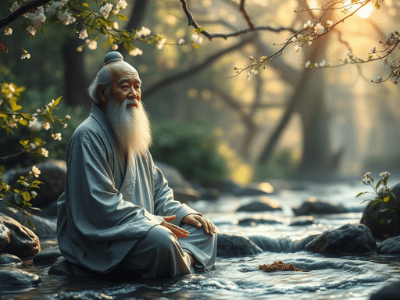
A “sage” is one who lives their life according to the virtue of the Dao (Liez, Chapter 6). Take some advice from the sage on how to live your life. Following these tips will help you enjoy the present more, worry less, and feel more peace of mind.
Daoism An Ancient Philosophy for the Modern Age. Get the book! A simple guide to help you navigate a stressful world. Key teachings from Daoism like constancy, compassion, flexibility, Yin-Yang, wu wei, success, happiness, leadership, and emptiness. Available on Apple and Amazon.
Dao
- It is the natural flow of the universe. It existed before creation and has never ending power. It created all things in existence and nothing can escape it. It has both form and no form, it is creation and nothingness. It is so complex that humans can not understand it or describe it in words. The Dao is the source of true virtue and never seeks authority. (Dao De Jing, Chapter 1, 4, 14, 25, 42, 73).
- The Dao is the way of the universe. It is formless, invisible, and the root of all things. It was from before creation and gave form to creation. It has always been here but is not considered old (Zhuangzi, Chapter 6).
- The Dao has always existed and gave form to all things. It creates endless change. It accomplishes all things yet does nothing (Liezi, Chapter 1).
- While the sage doesn’t understand the Dao, they realize it is responsible for creation. Life, death, reality, and dreams are all aspects of the Dao (Liezi, Chapter 3).
- The Dao is limitless and has no beginning. It makes up all things which are equal in the Dao (Liezi, Chapter 5).
- The Dao can be seen as nature or destiny. It is best to flow with nature becaf success and failure, life and death, are often out of a person’s control (Liezi, Chapter 6).
Constancy
- Constancy helps one explore and grow closer to the Dao. The best students will both listen and follow the Dao. As one grows more aware of the Dao, they will gain important virtues such as humility and simplicity. This allows one to see the Dao in everyday life (Dao De Jing, Chapter 64).
- The Dao is the source of all virtue and morality. This virtue differs from so-called human morality which is capricious and based on different classes (Dao De Jing, Chapter 32, 51).
- The sage accepts that change is the only constancy of life. Major changes include birth, growth, aging, and death. The sage is willing to accept any change including an early death or a long life. The sage makes no plans. They accept gain or loss, and live with no regrets. They find contentment in small things and do not let loss affect them. The Sage is unconcerned with success or failure and sees them both as fate (Zhuangzi, Chapter 6).
- They recognize the relativity of good and bad (Liezi, Chapter 5).
Compassion
- Compassion is a treasure that will allow one to succeed in life and be protected. It involves protecting others and making sure no one is discarded. Compassion can also be challenging because it requires one to be good to those who are not good (Dao De Jing, Chapter 67).
- The sage lives in harmony with others and is always sincere (Liezi, Chapter 2).
- They live in harmony with others, and are not arrogant (Liezi, Chapter 5).
- The sage is humble, generous, and compassionate and find contentment in savoring the present moment (Liezi, Chapter 7).
Flexibility
- One should adopt flexibility as the cornerstone of life. It can guide both personal and business decisions while reducing stress and anxiety. People should be pliant and yielding to reach their goals (Dao De Jing, Chapter 76).
- The constant change of Yin and Yang has important implications for the individual. It is foolish to think that life will always remain the same. The individual should assume that change is constant and develop a flexible attitude staying in the moment and reacting accordingly (Dao De Jing, Chapter 76).
- The individual should not find value in pride, fame, and power. Instead they should be content in finding usefulness all around them (Zhuangzi, Chapter 1).
- What works for one person does not necessarily work for another. The characteristics of kindness and morality are often dependent on the society, individual, or situation (Zhuangzi, Chapter 2).
- The sage is unhurried and goes along with the flow of life. They have a simple and uncomplicated existence (Zhuangzi, Chapter 2).
- The sage acknowledges that the Dao exists but does not waste their energy trying to define it. They do not get involved in needless arguments, but accepts life for what it is (Zhuangzi, Chapter 2).
- The sage is unaffected by strife and unconcerned about wealth, sickness, and death. They make themself one with the universe, live in simplicity, and allow things to be as they are (Zhuangzi, Chapter 2).
- The sage recognizes the absurdity of life and that they never will truly understand it (Zhuangzi, Chapter 2).
- The sage accepts life for what it is and accept their lack of control. They are grateful for the positive aspects of their life (Zhuangzi, Chapter 19).
- The sage seeks to always be flexible for they know that knows that yielding is winning while force is failure (Liezi, Chapter 2).
- The sage adapts to life (Liezi, Chapter 5).
Usefulness
- Usefulness is subjective to the time, space, and purpose. What may be useful for a large creature is not useful for a small one. What is useful for a long lived creature is not useful to a short lived one (Zhuangzi, Chapter 1).
- Sometimes usefulness can be found by shifting the perspective of how to use a thing. At first it may seem worthless but it may just be looking for the right purpose (Zhuangzi, Chapter 1).
- The sage recognizes that life is relative. They recognize the concepts of right and wrong are dependent on the individual and situation (Zhuangzi, Chapter 2).
- Daoism teaches that people are not happy unless they have freedom of choice. However, the sage recognizes that choices often have severe consequences (Zhuangzi, Chapter 3).
- Twisted trees may appear useless at first but often have an ultimate purpose and get to live out its normal years. A twisted body is much better than twisted virtue (Zhuangzi, Chapter 4).
- Individuals have different needs due to their biology, but are still connected as part of nature (Zhuangzi, Chapter 18).
- The sage never assumes they are right and considers the perspectives of others. They understand that perception defines reality (Liezi, Chapter 3).
Yin/Yang
- Yin and Yang are constantly interacting creating change (Dao De Jing, Chapter 76).
- Yin and yang create change and seeks balance. Moderation is a way to find harmony and includes finding a good work life balance (Liezi, Chapter 3).
- The sage stays in the moment and does not regret the past or worry about the future (Liezi, Chapter 3).
Wu Wei
- Wi Wei is action aligned with the Dao. It never strives and is always easy. It takes action without action. It yields to others to avoid aggression. It guides leaders to accomplish without using violence. It always takes the minimal action and then stops (Dao De Jing, Chapter 30).
- Although there is a time and place for assertive action, the Dao teaches that it is also necessary to yield. The Dao does not contend, but still achieves. It is laid back, but still plans. The concept of Wu Wei, or effortless action, illustrates this concept. One should go with the flow of life and act only when it is effortless and compliments the Dao (Dao De Jing, Chapter 73).
- The sage completes tasks by entering a state of Wu Wei or “effortless action.” This goes beyond being skillful or perceiving with the eyes. Instead it uses intuition to go along with the natural contours of the task. The person no longer does an action, but the action does itself (Zhuangzi, Chapter 3).
- They get the most out of the present moment by focusing on the task at hand. This allows them to be in a state of effortless action (Zhuangzi, Chapter 19).
- They only act if necessary and after much reflection (Zhuangzi, Chapter 26).
- The sage adapts to life and lives in harmony with others, are not arrogant, and do not rule others (Liezi, Chapter 5).
- They engage in Wu Wei to flow with nature. This exerts less energy and causes one to be more successful. They know that it is often better to take no action (Liezi, Chapter 8).
Success
- There is a single mindedness that comes with the Dao that makes it possible to accomplish challenging tasks (Liezi, Chapter 2).
- The sage is singleminded (Liezi, Chapter 5).
- They are part of nature and engage in Wu Wei to flow with nature. This exerts less energy and causes one to be more successful (Liezi, Chapter 8).
Happiness
- The sage is unhurried and goes along with the flow of life. They have a simple and uncomplicated existence (Zhuangzi, Chapter 2).
- Daoism teaches that people are not happy unless they have freedom of choice. However, the sage recognizes that choices often have severe consequences (Zhuangzi, Chapter 3).
- The sage acknowledges that they have a limited lifespan and can’t possibly know everything. One should never believe they have all the answers and are always right. Instead, remain grounded, avoid fame, and try not to break the law. Take care of your family and be content with the life that you have (Zhuangzi, Chapter 3).
- A twisted body is much better than twisted virtue (Zhuangzi, Chapter 4).
- Humanity values wealth, reputation, and power. However, these things do not guarantee happiness and can actually prevent it. Wealth brings a hectic life and worry about protecting possessions (Zhuangzi, Chapter 18).
- The sage finds happiness in the state of Wu Wei or effortless action. They only take action after much reflection when it seems natural in the moment (Zhuangzi, Chapter 18).
- Individuals have different needs due to their biology, but are still connected as part of nature (Zhuangzi, Chapter 18).
- The sage rejects money, possessions, power, and fame. They live a simple life and pursue what nourishes them (Zhuangzi, Chapter 19).
- The sage accepts life for what it is and accept their lack of control. They are grateful for the positive aspects of their life (Zhuangzi, Chapter 19).
- The sage rejects the human values of wealth, power, excess, and fame. They see that these external things do not bring happiness (Zhuangzi, Chapter 26).
- The sage finds happiness in all stages of life including birth, childhood, old age, and poverty (Liezi, Chapter 1).
- Moderation is a way to find harmony and includes finding a good work life balance. The sage stays in the moment and does not regret the past or worry about the future (Liezi, Chapter 3).
- The sage adapts to life (Liezi, Chapter 5).
- They find contentment in savoring the present moment. One should surround themselves with pleasant sounds, environments, smells, and express themselves freely (Liezi, Chapter 7).
- The sage ignores external distractions such as wealth, power, knowledge, and reputation. They know that status and wealth cause envy (Liezi, Chapter 8).
Leadership
- Nations should also abide by the Dao. Laozi (Lao Tzu) taught that nations should follow Wu Wei and be willing to yield to one another. Larger nations should not dominate smaller ones, because this leads to push back and conflict. Larger nations should be willing to yield and accommodate smaller ones to create positive and long lasting relationships (Dao De Jing, Chapter 61).
- Wu Wei also applies to the government. The government can press without marching, seize without using weapons, and push without opposing. Leaders should never take power in order to tamper with society. They are not fit to lead. One should never boast and never use violence to attain power (Dao De Jing, Chapters 30, 48, 57, and 69).
- Some leaders try to convince others to join them by being kind, making friends, and building relationships. The sage makes no effort to convince others. They simply exist in the moment and accept life as it is (Zhuangzi, Chapter 7).
- Most leaders create rules and regulations for their followers to ensure proper behavior. The sage resists making rules, but ensures they are correct before they act. Even then, they still only act in a limited way to create space for others to live (Zhuangzi, Chapter 7).
- Many leaders lord it over others. The sage goes along with life and doesn’t allow their personal views to affect others. They influence others but don’t let people depend on them. They give others freedom to live their life (Zhuangzi, Chapter 7).
- The sage does not try to move quickly or gain strength. They do not strive or study. It seems as if they do nothing at all, yet everything gets accomplished. They are not arrogant. They do not seek fame, plan, scheme, or seek out wisdom. They are content with what they have (Zhuangzi, Chapter 7).
- When a nation follows the Dao there is no need for leaders or laws. Everyone has what they require. The nation should always seek to avoid the use of force (Liezi, Chapter 2).
- They live in harmony with others, are not arrogant, and do not rule others (Liezi, Chapter 5).
- A leader acting in accordance with the Dao forgives others, is compassionate and inspirational. They are trusted, never bully others, and remain humble (Liezi, Chapter 6).
- A leader should recognizes their limitations, delegate to others, and remain orderly on the inside (Liezi, Chapter 8).
- Trying to reform others is often a dangerous proposition and will likely end in failure (Zhuangzi, Chapter 4).
- One must be sure in your own virtue before you try to teach others (Zhuangzi, Chapter 4).
- The best hope for success lies in being inwardly resolute and following your own way. You should never be motivated by fame. Only give advice if the other person is willing to listen (Zhuangzi, Chapter 4).
Emptiness
- One can use meditation to reach a state of emptiness. This can provide peace of mind and allow a person to get the most out of each moment (Dao De Jing, Chapter 35).
- The sage or wise person has great understanding of the Dao and shifts their focus to a more universal perspective. They do not let the stress of everyday life distract them (Zhuangzi, Chapter 2).
- The sage sees the unity of all things in the Dao and does not create artificial divisions (Zhuangzi, Chapter 2).
- The sage recognizes that death is simply a part of the natural pattern of the Dao. People are born, grow, decay, and then die. One should be content with their lifetime and accept this pattern without grief (Zhuangzi, Chapter 3).
- One enters a state of virtue when they shift their perspective to be in harmony with the Dao. They can be in harmony by viewing all of creation as interconnected. The Dao becomes a guide and one sees the unity of all things (Zhuangzi, Chapter 5).
- If someone has virtue the body is unimportant. It does not matter if someone is ugly, poor, or powerless. Physical disabilities or limitations are unimportant. The body is simply seen as a dwelling (Zhuangzi, Chapter 5).
- In this state one is unconcerned about life and death or the events of the day. The world could come to an end and it would not affect them. They do not fear death but see life and death as part of the Dao (Zhuangzi, Chapter 5).
- One in virtue is focused on the moment and do not allow joy or sorrow to affect them. They simply let things be as they are. They make no plans and do not allow loss to affect them. They do not care for profit, but only are concerned with being in harmony with the Dao (Zhuangzi, Chapter 5).
- Those approaching virtue admit to their faults and do not make excuses for their past behavior. They do not care for fame or ututation (Zhuangzi, Chapter 5).
- The sage becomes one with the Dao when they achieve an empty state. In this state, they are part of the world but also withdrawn. To reach emptiness, one must be willing to let go of the cares of the world, possessions, and life itself. When the sage reaches this state, past and future fade away. They are in the present moment and are unconcerned about life or death. They are simply living in the moment (Zhuangzi, Chapter 6).
- The sage doesn’t waste energy on trying to figure out why they are alive or when they will die. They remain calm in the face of adversity. The sage is content with the time they have to live. By being content emotions such as happiness and joy can not affect you (Zhuangzi, Chapter 6).
- The sage keeps life and death in proper perspective and realize that they are part of nature (Zhuangzi, Chapter 18).
- The sage finds balance between separating themselves from the world and being a part of it (Zhuangzi, Chapter 19).
- They work towards emptiness and the connection of all things. This allows them to live the world without being bothered by it (Zhuangzi, Chapter 26).
- The sage sees life as a gift and do not view death as a true end but a return to the Dao (Liezi, Chapter 1).
- The sage achieves a state of emptiness by accepting whatever comes (Liezi, Chapter 2).
- The sage focuses on the internal in order to navigate the external world (Liezi, Chapter 5).
- The focuses on the internal and seeks a state of emptiness. They are humble, generous, and compassionate and find contentment in savoring the present moment (Liezi, Chapter 7).
- The sage focuses on the internal and reaching a state of emptiness. They are part of nature and flow with nature (Liezi, Chapter 8).
 Daoism