
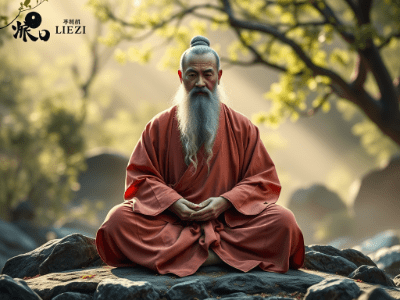
The Liezi is considered the third most important text in Daoism (Taoism) after the Dao De Jing and Zhuangzi. Chapter four is named Confucius and rejects external praise while focusing on internal truth.
Acceptance
The sage knows that social rules or customs are not the way to the Dao. Instead the sage accepts life as it comes with no preconditions.
“That’s how I came to realize that poetry and history, ritual and music, are no help in bringing order to chaos.”
“There is nothing one cannot accept, nothing one cannot acknowledge, nothing one is not concerned about.”
The sage strives to be compassionate, adaptable, reflective, and reserved.
“Yan Hui is capable of being humane, but not capable of change. Zigeng is capable of being eloquent but not capable of keeping silent. Zilu is capable of bravery but not capable of reticence. Zizhang is capable of being dignified, but not capable of conforming.”
Profit and Loss
The sage does not care about praise or condemnation.
“I do not consider it glorious to be praised by everyone in my hometown, and I do not consider it a disgrace to be vilified by everyone in the state.”
The sage does not worry about gain or loss.
“I do not delight in gain or sorrow over loss. I look upon wealth as I do poverty. I look upon humans as I do swine, I look upon myself as I do others.”
They accept both life and death.
“I look upon life as I do death.”
In this way pain, punishment, and loss have no effect.
“With all these ailments, rank and reward cannot encourage me, punishments and penalties cannot intimidate me. Prosperity and decline, gain and loss, cannot change me; sorrow and joy cannot move me.”
Influence and Leadership
The sage influencers others without governing them.
“He does not govern, yet there is no disorder; he is spontaneously trusted without saying anything, he is naturally effective without exerting influence. He is so great that the people cannot label him.”
Those who lead with power or control are not true leaders. They are ignorant of leadership and incompetent.
“And yet there is no leadership, no one able to put them to work. Instead, the leaders are ignorant, the employers are incompetent, and yet those who know this and are capable still work for them.”
Emptiness
The sage does not rely on the five senses, but instead strives for a state of emptiness. The mind, body, and spirit become one with the Dao.
“I am able to see and hear without using my eyes and ears.”
“My body merges with mind, mind merges with energy, energy merges with spirit, spirit merges with nothingness.“
“Don’t dwell on yourself, and things will be clear. Like water in movement, like a mirror in stillness, like an echo in response, the Way is thus in harmony with people.”
Travel is not taking a journey, but is a focus inward seeking emptiness.
“Those who travel outward seek completeness in things; those who gaze inward find sufficiency in themselves. Finding sufficiency in oneself is the goal of travel.”
The sage opens themselves up to the universe. They are not aware of their own thoughts, actions, or speech.
“After nine years, he gave free rein to thought and speech without being conscious of his own right or wrong or gain or loss, or others’ right or wrong or gain or loss. Inside and outside were ended. His mind was still, his body relaxed, his bones and muscles merged. He was not aware of what his body rested on, what his feet walked on, what his mind thought of, what his words contained.”
Always Alive
The Dao is responsible for all creation.
“What is always alive without coming from anywhere is the Way.”
One can achieve eternity when they are with the Dao. Even though their life ends it doesn’t truly perish.
“Attaining an end by means of the Way is called eternity. To die for a practical purpose is also referred to as the Way; to die by the Way is also called eternity.”
Conclusion
The sage knows that artificial rules are unimportant. One should accept what comes. The sage is compassionate and does not seek praise.
They influence others but do not command. They strive for emptiness where mind and body become one. The Way is responsible for all creation and though life ends, it doesn’t truly perish.
Resource
The Book of Master Lie, Thomas Cleary, translator. 2011. A nice translation of Liezi.



 Daoism