Zhuangzi Chapter 1: Free and Easy Wandering

Master Zhuang is the second most influential writer in Daoism (Taoism) and the book Zhuangzi was named after him. Chapter One is entitled Free and Easy Wandering and challenges our normal definition of usefulness. How useful a thing is depends on the sizes involved, lifespan, and purpose.

Usefulness Based on Size

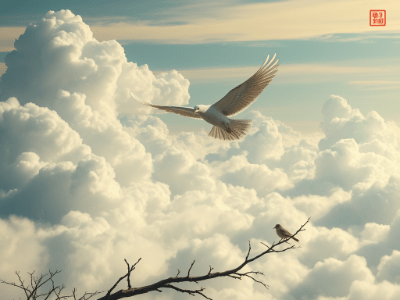
Usefulness depends on the relative sizes involved. There was a bird who measured a thousand miles wide and flew for nine months straight. It found the wind very useful in order to fly long distances. There was a small cicada and dove who could barely fly to the next tree. They did not find the wind useful because they only traveled a few yards. A massive gourd was useless to carry water because it became too heavy, but it could be used as a boat to float down a river.

Usefulness Based on Lifespan

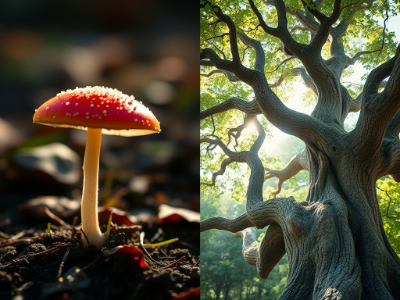
Usefulness is dependent on the lifespan involved. The morning mushroom does not see the twilight, the summer cicada does not see the spring. What was useful for these short lived beings are not useful to longer lived ones such as humans or animals.
Usefulness Based on Purpose

Usefulness also depends on the purpose a thing. A family had a secret recipe for chapped hands ointment and used it when bleaching silk in water. Over generations, they never made much money. They eventually sold the recipe to a traveler who gave it to soldiers to help them hold weapons during a battle. The army won and the king rewarded the traveler with much land. A gnarled and twisted tree may be worthless to a carpenter but may be perfect to provide shade. The same item is useless for one purpose but has much use for another.

Lesson for the Individual

Our personal circumstances often make it hard to see what is important in life. The small dove can’t understand why another would want to fly hundreds of miles because the dove only needs to travel a few yards. We often put significant value on our accomplishments even when they are relatively small. The dove may have an outsized pride in traveling just a few yards. A person shouldn’t take pride in their own accomplishments such as gaining fame, wealth, or power. The Daoist would say the individual shouldn’t be bothered by such things, but be content in finding usefulness in the everyday things around them.

Conclusion

Master Zhuang recognizes that usefulness is subjective to the time, space, and purpose. What may be useful for a large creature is not useful for a small one. What is useful for a long lived creature is not useful to a short lived one. Sometimes usefulness can be found by shifting the perspective of how to use a thing. At first it may seem worthless but it may just be looking for the right purpose. The individual should not find value in pride, fame, and power. Instead they should be content in finding usefulness all around them.

Resource

Complete Works Of Chuang Tzu, Burton Watson, translator. Columbia University Press, 1968. A good and classic translation of Chuang Tzu.
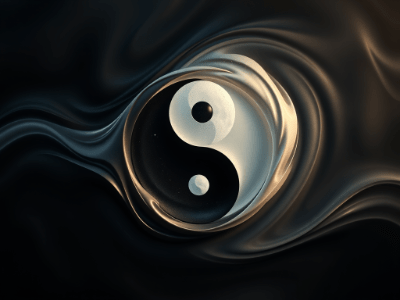
Yin Yang

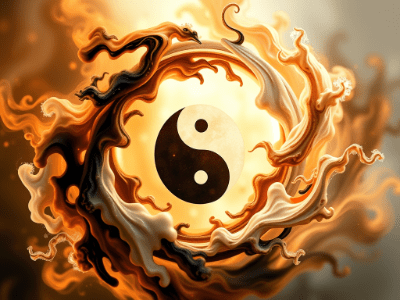
The Yin Yang symbol is well know in popular culture and can be found on all sorts of items from t-shirts to tattoos. While it is an essential part of Daoism (Taoism), it is often misunderstood. Many see Yin Yang as opposites like cold v. hot or good v. evil, but this is too simple a concept.

Complimentary Forces

Yin Yang do not so much oppose each other as they compliment one another. Yin is needed for Yang to exist. Without ugliness there can be no beauty. Without sour there can be no sweet. They shape each other and define each other.

Taking this even further creation and non-creation need each other. Creation comes from nothing and nothing comes from creation. Another way to say this is that being comes from non-being and non-being comes from being.

Constant Change

The interaction between Yin and Yang creates constant change making each moment unique. They create harmony by blending together. Some days its hotter, other days colder. Some days you are more social and other days more reserved.

Yielding

Although there is a time and place for assertive action, the Dao teaches that it is also necessary to yield. The Dao does not contend, but still achieves. It is laid back, but still plans. The concept of Wu Wei, or effortless action, illustrates this concept. One should go with the flow of life and act only when it is effortless and compliments the Dao.

Lessons for Government

Nations should also abide by the Dao. Laozi (Lao Tzu) taught that nations should follow Wu Wei and be willing to yield to one another. Larger nations should not dominate smaller ones, because this leads to push back and conflict. Larger nations should be willing to yield and accommodate smaller ones to create positive and long lasting relationships.

Lessons for the Individual

The constant change of Yin and Yang has important implications for the individual. It is foolish to think that life will always remain the same. Yin and Yang are constantly interacting creating change. The individual should assume that change is constant and develop a flexible attitude staying in the moment and reacting accordingly.

A person should be willing to embrace both Yin and Yang. Sometimes they should be outgoing while other time more reserved and contemplative. They should embrace both the masculine and feminine.

Flexibility

Daoism (Taoism) teaches us that life is constantly changing with the exchange of Yin and Yang. No two moments are exactly the same. The best way to live your life is to adapt to these changes by being flexible and in the moment. This mindset allows you to make important long term decisions and to adapt to sudden changes.

Aware and alert, ready for whatever may come.

Like water

It is important to be flexible and yielding when working towards your goals. Consider the analogy of water. Although water is soft it can be hit and suffer no harm. It can crash as a wave. Water adjusts to its environment and flows around obstacles as it seeks the lowest path.

A person should act in the same way and be willing to yield to solve conflicts. Although goals are important, one should be be flexible in how to reach those goals. To be willing to change those goals if they no longer make sense.

Inflexibility equals Death

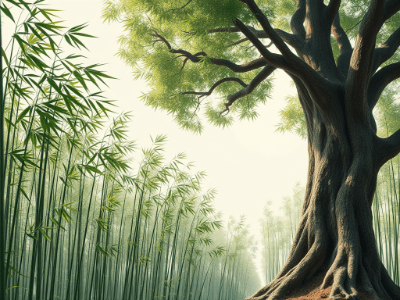
Daoism teaches that flexibility represents life while rigidness represents death. Consider the analogy of the mighty oak tree and simple bamboo. Although the oak tree is tall and strong, it can be destroyed in a strong storm because it does not bend. On the other hand the bamboo bends with the wind and survives.

The mighty oak tree will fall in a mighty wind because it is inflexible.

Conclusion

One should adopt flexibility as the cornerstone of life. It can guide both personal and business decisions while reducing stress and anxiety. People should be pliant and yielding to reach their goals.