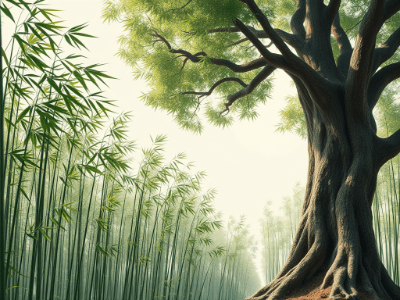

Zhuangzi Chapter 18: Supreme Happiness

The book Zhuangzi is an essential text in Daoism. Chapter Eighteen, Supreme Happiness, centers on the question of what do humans value? Can money buy happiness? What must a person do to be happy?

Happiness

This chapter begins with the essential question, “Can one be happy in life?”

Human Values

Humanity values wealth, reputation, power, and long life. Many find happiness in fashionable clothes, rich food, leisure activities, music, and beauty. Humanity doesn’t value poverty, a short life, or a hectic lifestyle.

Wealthy

The wealthy rush around all day accumulating wealth. They engage in complex business dealings, long term planning, and questionable schemes. They accumulate more wealth than they could possibly use in their lifetime. They worry if they are making the right decisions.

Wealth does not bring one true happiness. The rich are too rushed and can’t slow down to enjoy the moment. They are constantly worrying about protecting their possessions. They convince themselves that money will make them happy.

True Happiness

The sage does not accumulate possessions. They find true happiness in the state of Wu Wei or effortless action. They follow the natural contours of life and do not force anything. They only take action after much reflection and when it seems natural in the moment. This state of “inaction” brings peace and clarity and helps determine what is right and wrong. It feels as if things get done all by themselves and everything that needs to gets done gets done.

Life and Death

The sage keeps life and death in proper perspective. They mourn the loss of a loved one, but also realize that life and death are part of nature. There was a time before birth and having a body or spirit. One is born, grows, and finally dies. This is the progression of things.

In fact the dead would not choose to be alive again because they wouldn’t give up the peacefulness of death for the troubles of life.

People have different Needs

A sage knows that people have different needs. A bird travels in a flock, likes the forest, eats fish, and hates human noise. Fish swim in the water and eat insects. Humans aren’t birds or fish so they have different needs than them.

Individuals have different needs due to their biology, environment, and life experiences. A seed grows differently in water, on the bank of a stream, or on the side of a slope.

Interconnectedness

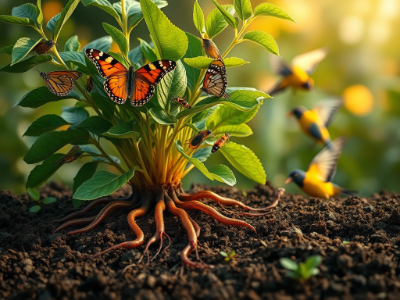
The sage knows that all living things are connected. Roots of a plant need rich soil to grow. Worms eat its roots while butterflies eat its leaves. Birds eat butterflies and animals eat plants. Humans eat all of these but eventually pass away and return to the soil.

Conclusion

What is happiness? Humanity values wealth, reputation, and power. However, these things do not guarantee happiness and can actually prevent it. Wealth brings a hectic life and worry about protecting possessions. The sage finds happiness in the state of Wu Wei or effortless action. They only take action after much reflection when it seems natural in the moment. The sage keeps life and death in proper perspective and realize that they are part of nature. Individuals have different needs due to their biology, but are still connected as part of nature.

Resource

Complete Works Of Chuang Tzu, Burton Watson, translator. Columbia University Press, 1968. A good and classic translation of Chuang Tzu.


Zhuangzi Chapter 17: Autumn Floods

The book Zhuangzi is an essential text in Daoism. Chapter Seventeen, Fit for Emperors and Kings, describes having an expansive perspective on life and seeing the unity of all things. The sage seeks emptiness and sees that there is truly no division between life and death, right and wrong, or past and present. This chapter differs significantly from the inner chapters because it focuses on one long conversation between the Yellow River and the North Sea.

Pride

During the Autumn floods, streams poured into the Yellow River making it overflow its banks. The Lord of the River was full of pride at how powerful he had become. However, when he made it to the North Sea he became humbled by its vastness.

Perspective

Ruo of the North Sea was so vast that it gave the Yellow River a more expansive perspective. He realized that he had been so vain. This is a common occurrence with many not seeing the big picture. A frog in the well can’t understand the ocean. An insect in the summer has no conception of winter. A scholar locked into their own beliefs can’t understand the Way.

Large v. Small

This expanded perspective also means that size doesn’t matter. A small amount of time is just as important as a large. A near place as important as a far place. Short as meaningful as long.

Past v. Present

With this expanded perspective, one realizes that there is no division between past and present. Time is connected and flows on unceasingly.

Life and Death

Because time always continues, death need not be feared. The time a person is alive does not compare to the time before they were born.

Life has a natural rhythm in which all things progress. They are born, grow, decay, and finally die.

Right v. Wrong

One with proper perspective realizes that both right and wrong are subjective and vary from society to society. What is considered right in one culture is wrong in another.

Usefulness

Expanding perspective helps the sage understand that nothing is truly useless. Usefulness depends on the point of view of the individual.

Usefulness also depends on the specific circumstances of the situation. Somethings will work in certain situations but not others. A beam can be used to break a wooden door, but not to plug up a small hole.

All beings have different needs. The frog is happy in a small well while the great turtle is happiest in the wide sea.

The sage realizes that all act according to their nature. The millipede moves with ten thousand legs while the snake moves using its backbone. The wind moves without any physical form.

Harmony

If one has an expansive perspective they see the connection of all things. The sage seeks harmony and balance. They do not harm others, yet don’t flaunt their pacifism. They do not seek profit but don’t condemn others for doing so. They do not accumulate possessions, yet don’t brag about their un-attachment. They do not ask for help, but don’t tout their self sufficiency. They do not seek fame, but do not judge others that do. They live simply with what has been given to them.

In a state of harmony one can tell the difference between safety and danger. One can accept both fortune and misfortune. In this way the sage does not allow negative circumstances to harm them because they don’t see them as negative. They are simply part of the up and downs of life.

Nature v. Humanity

The sage follows the way of nature and not the way of humanity. Nature gives us life, physical form, and a set of skills and limitations. Humanity gives us culture and rules.

The sage does not allow human values such as fame and desire to keep one away from following their own nature.

Success Depends on Circumstances

The sage recognizes that circumstances play an oversized role in success or failure. Often one has to be at the right time and place to be successful.

Refuse Responsibility

The sage is not interested in power or leadership. They refuse such roles and stick to the way of nature.

Conclusion

The sage seeks an expanded perspective viewing the unity of all things. There is no real division between large and small, past and present, right and wrong, or life and death. Life simply follows the rhythm of birth, aging, and death. Nothing is truly useless. All beings have different needs according to their nature. The sage seeks harmony and follows the way of nature and not the way of humanity which includes power, pride, and fame.

Zhuangzi Chapter 7: Fit for Emperors and Kings

Master Zhuang is the second most influential writer in Daoism and the book Zhuangzi was named after him. Chapter Seven is Fit for Emperors and Kings and describes what leadership should look like.

Manipulation

Some leaders try to convince others to join them by being kind, making friends, and building relationships. The sage makes no effort to convince others. They simply exist in the moment and accept life as it is.

Rules

Most leaders create rules and regulations for their followers to ensure proper behavior. The sage resists making rules, but ensures they are correct before they act. Even then, they still only act in a limited way to create space for others to live.

Freedom

Many leaders lord it over others. The sage goes along with life and doesn’t allow their personal views to affect others. They influence others but don’t let people depend on them. They give others freedom to live their life.

Do Nothing At All

The sage does not try to move quickly or gain strength. They do not strive or study. It seems as if they do nothing at all, yet everything gets accomplished. They are not arrogant. They do not seek fame, plan, scheme, or seek out wisdom. They are content with what they have.

Emptiness

The sage is connected to the earth. They are calm, still, and reflective. They are of this world yet aware of all existence. They adapt to the situation and seek balance. They are empty and do not get entangled. They do not try to understand the external world but attempt to become empty inwardly.

Conclusion

The sage does not try to convince others to their cause. They exist in the moment. They do not create rules for others to follow but only take limited action. They positively influence others but never manipulate them. The give others the space to be themselves. The sage does not strive yet accomplishes everything that is needed. The sage works towards emptiness. They are calm, reflective, and do not get entangled. They are a mirror reflecting things around them.

Zhuangzi Chapter 6: The Great and Venerable Teacher

Master Zhuang is the second most influential writer in Daoism and the book Zhuangzi was named after him. Chapter Six is The Great and Vulnerable Teacher and describes how the sage becomes one with the Dao. Other terms for the sage are the perfect man, holy man, and true man.

Description of the Way

The Dao is the way of the universe. It is formless, invisible, and the root of all things. It was from before creation and gave form to creation. It has always been here but is not considered old.

Emptiness

The sage becomes one with the Dao when they achieve an empty state. In this state, they are part of the world but also withdrawn.

To reach emptiness, one must be willing to let go of the cares of the world, possessions, and life itself.

When the sage reaches this state, past and future fade away. They are in the present moment and are unconcerned about life or death. They are simply living in the moment.

The Only Constancy is Change

The sage accepts that change is the only constancy of life. Major changes include birth, growth, aging, and death.

The sage is willing to accept any change including an early death or a long life.

The sage makes no plans. They accept gain or loss, and live with no regrets. They find contentment in small things and do not let loss affect them.

The Sage is unconcerned with success or failure and sees them both as fate.

Life and Death

The sage doesn’t waste energy on trying to figure out why they are alive or when they will die. They remain calm in the face of adversity.

When Master Yu suffered illness he held no resentment. He knew that his life would eventually end and he would return to the Dao.

The sage is content with the time they have to live. By being content emotions such as happiness and joy can not affect you.

The Non-Sage

It is helpful to contrast the sage with the non-sage. The non-sage gets lost in the passion of their daily life. They strive to succeed, become wealthy, or get fame. They are always busy and plan out their days to ensure success.

Conclusion

A person can be compared to a piece of metal being cast by a smith. The metal can not demand to be made into a sword or other object but must accept their fate according to the wishes of the smith. In the same way, the sage accepts the changes in their life. They do not allow events such as success, failure, illness, health, a long life, or a short life to affect them.

Zhuangzi Chapter 5: Sign of Virtue Complete

Master Zhuang is the second most influential writer in Daoism (Taoism) and the book Zhuangzi was named after him. Chapter Five is The Sign of Virtue Complete and describes what a sage looks like who is in a state of virtue.

Interconnectedness

One enters this state when they shift their perspective to be in harmony with the Dao.

They can be in harmony by viewing all of creation as interconnected. The Dao becomes a guide and one sees the unity of all things.

Admit Faults

Those approaching virtue admit to their faults and do not make excuses for their past behavior. They do not care for fame or reputation.

In the Moment

They are focused on the moment and do not allow joy or sorrow to affect them. They simply let things be as they are.

They make no plans and do not allow loss to affect them. They do not care for profit, but only are concerned with being in harmony with the Dao.

The Body

If someone has virtue the body is unimportant. It does not matter if someone is ugly, poor, or powerless. A man of virtue named Ai Taituo was considered ugly and was not powerful or wealthy. However, women wanted to be near him and the rich wanted him to run their estates.

Physical disabilities or limitations are unimportant. The body is simply seen as a dwelling.

Life and Death

In this state one is unconcerned about life and death or the events of the day. The world could come to an end and it would not affect them.

They do not fear death but see life and death as part of the Dao. Wang Tai was in virtue and many wanted to be his disciples. It didn’t matter that he had been a criminal or that he didn’t formally teach.

Conclusion

The Sage is one who is in a state of virtue. One enters this state when they are in harmony with the Dao and view all of creation as interconnected. They can admit their faults and do not care for fame or wealth. They live in the moment and do not allow sorrow to affect them. It doesn’t matter if the person is ugly, poor, or without power. They are not concerned with death and see the body as a dwelling.

The Way

The Dao was in existence before creation.

It is changeless, runs in cycles, and has never ending energy.

The Dao created heaven, earth, and all things in existence.

It brought about the planets, universe, and sky. It has created plants, animals, insects, and creatures both large and small.

The Dao created the one which multiplied to all things in creation.

The Dao is in All Things

It can be found on earth, in heaven, and in nature. Nothing escapes it. It is in all of creation.

Nothing can escape the Dao. It is found everywhere.

Although the Dao is found in all things, it is also hidden. It has no form and can not be seen.

The Dao includes both existence and non-existence. Both creation and nothingness.

The Dao has both physical form and is without form.

It is so expansive and unknown that it is unfathomable to the human mind.

It is so complex that it can not adequately be described in human language.

True Virtue

The Dao is the source of all virtue and morality.

This virtue differs from so-called human morality which is capricious and based on different classes.

The Dao is yielding, yet it still has accomplished all of creation.

It never seeks acclaim or authority. It is humble and does not strive for greatness.

It is always impartial and never biased.

Conclusion

What is the Dao? It is the natural flow of the universe. It existed before creation and has never ending power. It created all things in existence and nothing can escape it. It has both form and no form, it is creation and nothingness. It is so complex that humans can not understand it or describe it in words. The Dao is the source of true virtue and never seeks authority.

Constancy

Constancy is important to grow closer to the Dao (Tao) and is major a theme throughout the Dao De Jing (Tao Te Ching). One may get closer to the Dao by simplifying their life, getting rid of unused possessions, meditating, and spending time in nature. This can help achieve peace of mind.

Beginning

Constancy is important when beginning to learn about the Dao. Just like a mighty tree starts from a tiny seed, a tall building starts with the foundation, all journeys begin with the first step. Constancy starts us down the path to explore the Dao.

Student of the Dao

The best student of the Dao has constancy. They listen to its way and follow its teachings. An average student listens but does not always follow. A poor student listens but laughs at the Dao.

Knowledge, Virtue, and the Dao

Once one gains knowledge, that knowledge leads to the virtues of humility, simplicity and being guided by nature.

Eventually these virtues lead to peace of mind and the Dao itself.

Once the connection with the Dao has grown, it will be found in all things in nature, no matter how large or small. This includes mountains, water, animals, insects, and plants.

Constancy is also important to stay connected with the Dao. Often people will almost reach their goal but not quite achieve it. The same applies to the journey of growing closer to the Dao.

Conclusion

Constancy helps one explore and grow closer to the Dao. The best students will both listen and follow the Dao. As one grows more aware of the Dao, they will gain important virtues such as humility and simplicity. This allows one to see the Dao in everyday life.

Yin Yang

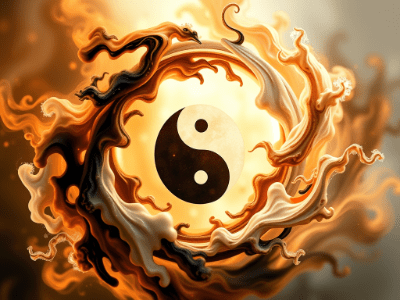
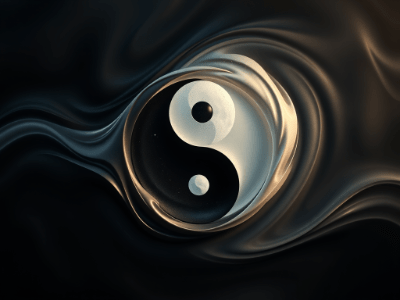
The Yin Yang symbol is well know in popular culture and can be found on all sorts of items from t-shirts to tattoos. While it is an essential part of Daoism (Taoism), it is often misunderstood. Many see Yin Yang as opposites like cold v. hot or good v. evil, but this is too simple a concept.

Complimentary Forces

Yin Yang do not so much oppose each other as they compliment one another. Yin is needed for Yang to exist. Without ugliness there can be no beauty. Without sour there can be no sweet. They shape each other and define each other.

Taking this even further creation and non-creation need each other. Creation comes from nothing and nothing comes from creation. Another way to say this is that being comes from non-being and non-being comes from being.

Constant Change

The interaction between Yin and Yang creates constant change making each moment unique. They create harmony by blending together. Some days its hotter, other days colder. Some days you are more social and other days more reserved.

Yielding

Although there is a time and place for assertive action, the Dao teaches that it is also necessary to yield. The Dao does not contend, but still achieves. It is laid back, but still plans. The concept of Wu Wei, or effortless action, illustrates this concept. One should go with the flow of life and act only when it is effortless and compliments the Dao.

Lessons for Government

Nations should also abide by the Dao. Laozi (Lao Tzu) taught that nations should follow Wu Wei and be willing to yield to one another. Larger nations should not dominate smaller ones, because this leads to push back and conflict. Larger nations should be willing to yield and accommodate smaller ones to create positive and long lasting relationships.

Lessons for the Individual

The constant change of Yin and Yang has important implications for the individual. It is foolish to think that life will always remain the same. Yin and Yang are constantly interacting creating change. The individual should assume that change is constant and develop a flexible attitude staying in the moment and reacting accordingly.

A person should be willing to embrace both Yin and Yang. Sometimes they should be outgoing while other time more reserved and contemplative. They should embrace both the masculine and feminine.

Wu Wei

One should live according to the Way by using Wu Wei or “effortless action.” This involves not forcing but accomplishing without doing. In most cases, no action should be taken. In rare cases, an action may be taken after much reflection. However, any action should be as minimal as possible.

Non-Striving

Wu Wei never strives. It is never forced. It is easy, yet resolves difficult situations. All great accomplishments must begin with a small action. It does not struggle for greatness but still achieves it. It teaches by example and avoids unnecessary words (Dao De Jing, Chapters 3, 6, 38, 43, 48, 63, and 77).

Non-action

Wu Wei is non-action. It does without doing, works without working, and talks without talking. It does not speak or call, yet all come to it. It decreases efforts and does not take useless action. It does not seek praise (Dao De Jing, Chapter 24, 48, and 77).

Yielding

Wu Wei is the “Virtue of not Contending.” It yields to avoid a reaction. The Law of Aggression states that aggressive acts provokes even more aggression. Wu Wei does not injure but still accomplishes. If you force something you will destroy it. If you grasp something you will lose it (Dao De Jing, Chapter 22, 64, 68, 69, 73, 77 and 81; Taoism: The Parting of the Way, Holmes H. Welch Jr.).

Government

Wu Wei also applies to the government. The government can press without marching, seize without using weapons, and push without opposing. Leaders should never take power in order to tamper with society. They are not fit to lead. One should never boast and never use violence to attain power (Dao De Jing, Chapters 30, 48, 57, and 69).

Minimal Action

Wu Wei achieves its desired outcome and then stops. It does not force, destroy, or act arrogantly. It does not boast or use violence (Dao De Jing, Chapter 30)

Conclusion

Wi Wei is action aligned with the Dao. It never strives and is always easy. It takes action without action. It yields to others to avoid aggression. It guides leaders to accomplish without using violence. It always takes the minimal action and then stops.

Flexibility

Daoism (Taoism) teaches us that life is constantly changing with the exchange of Yin and Yang. No two moments are exactly the same. The best way to live your life is to adapt to these changes by being flexible and in the moment. This mindset allows you to make important long term decisions and to adapt to sudden changes.

Aware and alert, ready for whatever may come.

Like water

It is important to be flexible and yielding when working towards your goals. Consider the analogy of water. Although water is soft it can be hit and suffer no harm. It can crash as a wave. Water adjusts to its environment and flows around obstacles as it seeks the lowest path.

A person should act in the same way and be willing to yield to solve conflicts. Although goals are important, one should be be flexible in how to reach those goals. To be willing to change those goals if they no longer make sense.

Inflexibility equals Death

Daoism teaches that flexibility represents life while rigidness represents death. Consider the analogy of the mighty oak tree and simple bamboo. Although the oak tree is tall and strong, it can be destroyed in a strong storm because it does not bend. On the other hand the bamboo bends with the wind and survives.

The mighty oak tree will fall in a mighty wind because it is inflexible.

Conclusion

One should adopt flexibility as the cornerstone of life. It can guide both personal and business decisions while reducing stress and anxiety. People should be pliant and yielding to reach their goals.