

The book Zhuangzi is an essential text in Daoism. Chapter Seventeen, Fit for Emperors and Kings, describes having an expansive perspective on life and seeing the unity of all things. The sage seeks emptiness and sees that there is truly no division between life and death, right and wrong, or past and present. This chapter differs significantly from the inner chapters because it focuses on one long conversation between the Yellow River and the North Sea.
Pride
During the Autumn floods, streams poured into the Yellow River making it overflow its banks. The Lord of the River was full of pride at how powerful he had become. However, when he made it to the North Sea he became humbled by its vastness.
“The time of the autumn floods came, and the hundred streams poured into the Yellow River. Its racing current swelled to such proportions that, looking from bank to bank or island to island, it was impossible to distinguish a horse from a cow. Then the Lord of the River! was beside himself with joy, believing that all the beauty in the world belonged to him alone. Following the current, he journeyed east until at last he reached the North Sea.”
Perspective

Ruo of the North Sea was so vast that it gave the Yellow River a more expansive perspective. He realized that he had been so vain. This is a common occurrence with many not seeing the big picture. A frog in the well can’t understand the ocean. An insect in the summer has no conception of winter. A scholar locked into their own beliefs can’t understand the Way.
“Ruo of the North Sea said, ‘You can’t discuss the ocean with a well frog—he’s limited by the space he lives in. You can’t discuss ice with a summer insect—he’s bound to a single season. You can’t discuss the Way with a cramped scholar—he’s shackled by his doctrines. Now you have come out beyond your banks and borders and have seen the great sea—so you realize your own pettiness.’”
Large v. Small
This expanded perspective also means that size doesn’t matter. A small amount of time is just as important as a large. A near place as important as a far place. Short as meaningful as long.
“Therefore great wisdom observes both far and near, and for that reason, it recognizes small without considering it paltry, recognizes large without considering it unwieldy, for it knows that there is no end to the weighing of things.”
Past v. Present
With this expanded perspective, one realizes that there is no division between past and present. Time is connected and flows on unceasingly.
“It has a clear understanding of past and present, and for that reason, it spends a long time without finding it tedious, a short time without fretting at its shortness, for it knows that time has no end.”
Life and Death
Because time always continues, death need not be feared. The time a person is alive does not compare to the time before they were born.
“Calculate the time he is alive, and it cannot compare with the time before he was born. Yet the time before he was born. Yet man takes something so small and tries to exhaust the dimensions of something so large!”
Life has a natural rhythm in which all things progress. They are born, grow, decay, and finally die.
“The Way is without beginning or end, but things have their life and death—you cannot rely on their fulfillment. One moment empty, the next moment full—you cannot depend on their form. The years cannot be held off; time cannot be stopped. Decay, growth, fullness, and emptiness end and then begin again. It is thus that we must describe the plan of the Great Meaning and discuss the principles of the ten thousand things.”
Right v. Wrong
One with proper perspective realizes that both right and wrong are subjective and vary from society to society. What is considered right in one culture is wrong in another.
“He knows that no line can be drawn between right and wrong, no border can be fixed between great and small.“
“From the point of view of preference, if we regard a thing as right because there is a certain right to it, then among the ten thousand things there are none that are not right. If we regard a thing as wrong because there is a certain wrong to it, then among the ten thousand things there are none that are not wrong.“
Usefulness

Expanding perspective helps the sage understand that nothing is truly useless. Usefulness depends on the point of view of the individual.
“From the point of view of function, if we regard a thing as useful because there is a certain usefulness to it, then among all the ten thousand things there are none that are not useful. If we regard a thing as useless because there is a certain uselessness to it, then among the ten thousand things there are none that are not useless.”
Usefulness also depends on the specific circumstances of the situation. Somethings will work in certain situations but not others. A beam can be used to break a wooden door, but not to plug up a small hole.
“A beam or pillar can be used to batter down a city wall, but it is no good for stopping up a little hole—this refers to a difference in function. Thoroughbreds like Qiji and Hualiu could gallop a thousand li in one day, but when it came to catching rats, they were no match for the wildcat or the weasel—this refers to a difference in skill. The horned owl catches fleas at night and can spot the tip of a hair, but when daylight comes, no matter how wide it opens its eyes, it cannot see a mound or a hill—this refers to a difference in nature. ”
All beings have different needs. The frog is happy in a small well while the great turtle is happiest in the wide sea.
“What fun I have! I come out and hop around the railing of the well, or I go back in and take a rest in the wall where a tile has fallen out. When I dive into the water, I let it hold me up under the armpits and support my chin, and when I slip about in the mud, I bury my feet in it and let it come up over my ankles. I look around at the mosquito larvae and the crabs and tadpoles, and I see that none of them can match me. To have complete command of the water of one whole valley and to monopolize all the joys of a caved-in well—this is the best there is! Why don’t you come some time and see for yourself?“
“But before the great turtle of the Eastern Sea had even gotten his left foot in the well, his right knee was already wedged fast. He backed out and withdrew a little, and then began to describe the sea. ‘A distance of a thousand li cannot indicate its greatness; a depth of a thousand fathoms cannot express how deep it is.”
The sage realizes that all act according to their nature. The millipede moves with ten thousand legs while the snake moves using its backbone. The wind moves without any physical form.
“’Now how in the world do you manage to work all those ten thousand legs of yours?’ The millipede said, ‘You don’t understand. Haven’t you ever watched a man spit? He just gives a hawk and out it.’”
“The snake said, ‘It’s just the heavenly mechanism moving me along—how can I change the way I am? What would I do with legs if I had them?’”
“The snake said to the wind, ‘I move my backbone and ribs and manage to get along, though I still have some kind of body. But now you come whirling up from the North Sea and go whirling off to the South Sea, and you don’t seem to have any body.”
Harmony
If one has an expansive perspective they see the connection of all things. The sage seeks harmony and balance. They do not harm others, yet don’t flaunt their pacifism. They do not seek profit but don’t condemn others for doing so. They do not accumulate possessions, yet don’t brag about their un-attachment. They do not ask for help, but don’t tout their self sufficiency. They do not seek fame, but do not judge others that do. They live simply with what has been given to them.
“Therefore the Great Man in his actions will not harm others, but he makes no show of benevolence or charity. He will not move for the sake of profit, but he does not despise the porter at the gate. He will not wrangle for goods or wealth, but he makes no show of refusing or relinquishing them. He will not enlist the help of others in his work, but he makes no show of being self-supporting, and he does not despise the greedy and base.“
In a state of harmony one can tell the difference between safety and danger. One can accept both fortune and misfortune. In this way the sage does not allow negative circumstances to harm them because they don’t see them as negative. They are simply part of the up and downs of life.
“He who understands the Way is certain to have command of basic principles. He who has command of basic principles is certain to know how to deal with circumstances. And he who knows how to deal with circumstances will not allow things to do him harm. When a man has perfect virtue, fire cannot burn him, water cannot drown him, cold and heat cannot afflict him, birds and beasts cannot injure him. I do not say that he makes light of these things. I mean that he distinguishes between safety and danger, contents himself with fortune or misfortune, and is cautious in his comings and goings. Therefore nothing can harm him.“
Nature v. Humanity
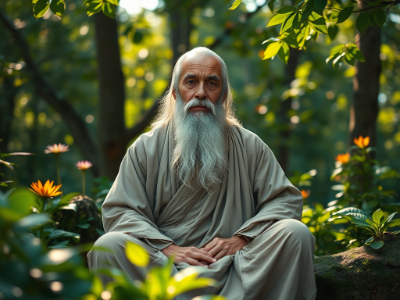
The sage follows the way of nature and not the way of humanity. Nature gives us life, physical form, and a set of skills and limitations. Humanity gives us culture and rules.
“’What do you mean by the Heavenly and the human?’” Ruo of the North Sea said, ‘Horses and oxen have four feet—this is what I mean by the Heavenly. Putting a halter on the horse’s head, piercing the ox’s nose—this is what I mean by the human.’”
The sage does not allow human values such as fame and desire to keep one away from following their own nature.
“So I say: do not let what is human wipe out what is Heavenly; do not let what is purposeful wipe out what is fated; do not let [the desire for] gain lead you after fame. Be cautious, guard it, and do not lose it—this is what I mean by returning to the True.”
Success Depends on Circumstances
The sage recognizes that circumstances play an oversized role in success or failure. Often one has to be at the right time and place to be successful.
“For a long time I have tried to stay out of the way of hardship. That I have not managed to escape it is due to fate. For a long time I have tried to achieve success. That I have not been able to do so is due to the times. It is time and circumstance that make it so.”
“My fate has been decided for me.”
Refuse Responsibility
The sage is not interested in power or leadership. They refuse such roles and stick to the way of nature.
“Once, when Zhuangzi was fishing in the Pu River, the king of Chu sent two officials to go and announce to him: ‘I would like to trouble you with the administration of my realm.’ Zhuangzi held on to the fishing pole and, without turning his head, said, ‘I have heard that there is a sacred tortoise in Chu that has been dead for three thousand years. The king keeps it wrapped in cloth and boxed, and stores it in the ancestral temple. Now would this tortoise rather be dead and have its bones left behind and honored? Or would it rather be alive and dragging its tail in the mud?’ ‘I would rather be alive and dragging its tail in the mud,’ said the two officials. Zhuangzi said, “Go away! I’ll drag my tail in the mud!”
Conclusion
The sage seeks an expanded perspective viewing the unity of all things. There is no real division between large and small, past and present, right and wrong, or life and death. Life simply follows the rhythm of birth, aging, and death. Nothing is truly useless. All beings have different needs according to their nature. The sage seeks harmony and follows the way of nature and not the way of humanity which includes power, pride, and fame.









 Daoism